
 MOHAMMAD ABUBAKR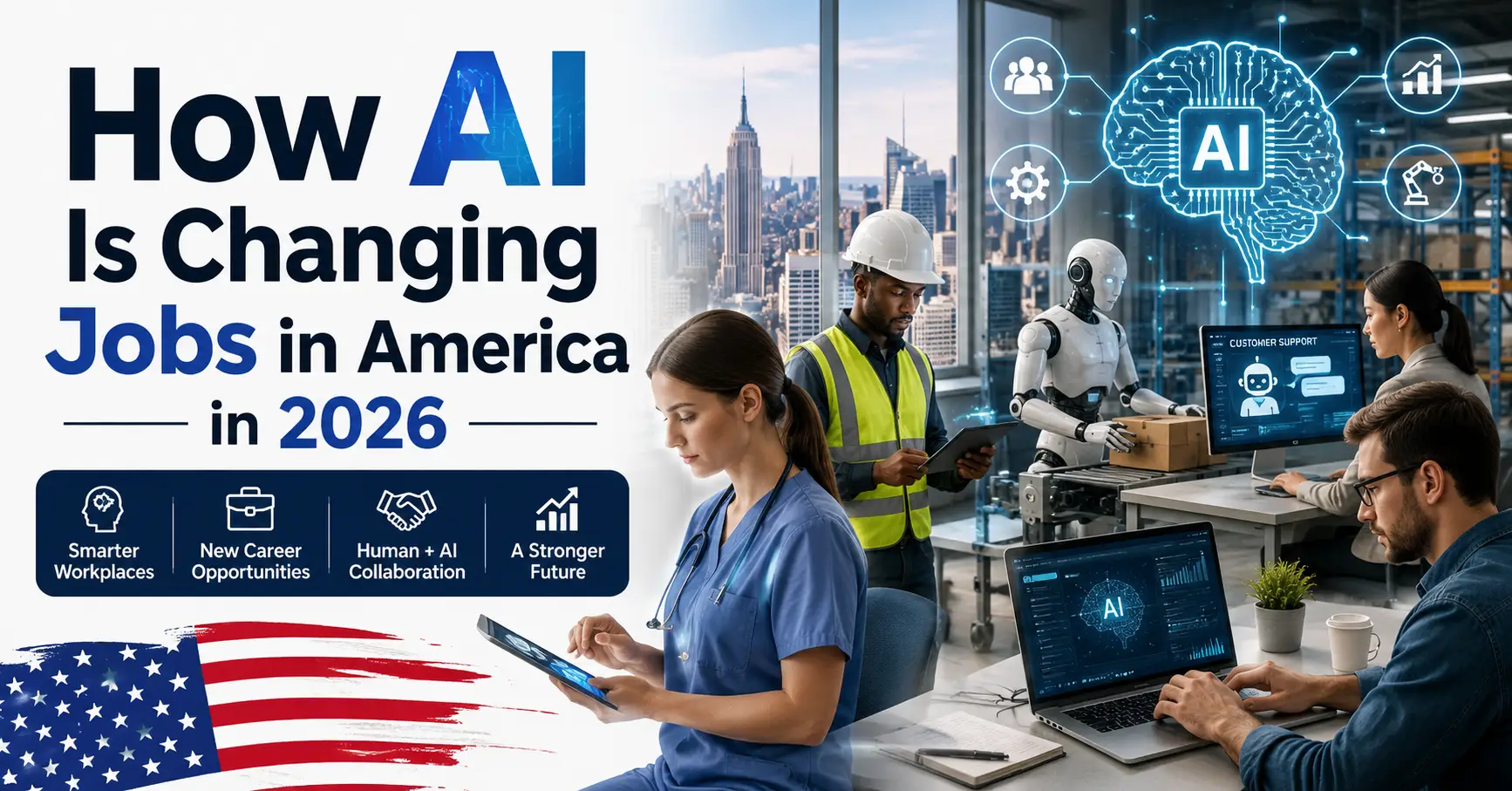
Artificial intelligence (AI) is transforming the American workforce faster than ever before. How AI Is Changing Jobs in America has become one of the biggest topics in today’s economy as businesses across healthcare, finance, manufacturing, retail, and customer service adopt AI-powered technologies. Companies are using artificial intelligence to improve productivity, reduce costs, and automate repetitive tasks.
While some workers worry that AI will replace jobs, experts believe the technology is more likely to change how people work rather than eliminate employment entirely. New career opportunities are emerging just as quickly as traditional roles evolve.
In this article, we’ll explore how AI is changing jobs in America, which industries are seeing the biggest impact, and what workers can do to prepare for the future.
Why AI Adoption Is Accelerating
Advancements in machine learning, cloud computing, and generative AI tools have made artificial intelligence more affordable and accessible for businesses of every size. These innovations are also reshaping financial markets, as explained in our guide Is the Stock Market Overvalued Right Now? What Investors Need to Know in 2026.
Companies are adopting AI because it helps them improve productivity and reduce operational costs. According to the Future of Jobs Report, AI will continue reshaping employment trends across industries.
- Automate repetitive tasks
- Improve customer service
- Analyze large amounts of data
- Increase workplace efficiency
- Reduce operational costs
- Make faster business decisions
Instead of replacing every employee, many organizations are using AI to support workers and improve productivity.
Industries Experiencing the Biggest AI Impact
Healthcare
Hospitals and clinics use AI to assist doctors with medical imaging, patient scheduling, disease detection, and administrative work.
Healthcare professionals still make the final decisions, but AI helps save valuable time.
Manufacturing
Factories increasingly rely on AI-powered robots to perform repetitive production tasks, quality inspections, and equipment monitoring.
Workers are shifting toward operating, maintaining, and programming automated systems.
Finance
Banks and financial institutions use AI for:
- Fraud detection
- Credit risk analysis
- Investment research
- Customer support
- Loan processing
Financial professionals now spend less time on manual analysis and more time providing strategic advice.
Retail
Retailers use AI to manage inventory, recommend products, forecast demand, and personalize shopping experiences.
Online stores also use AI-powered chatbots that answer customer questions around the clock.
Transportation
Self-driving technologies, route optimization, and predictive maintenance are helping transportation companies improve safety and reduce costs.
Although fully autonomous vehicles are still developing, AI already assists drivers and logistics teams every day.
Jobs Most Likely to Change
Some occupations involve repetitive tasks that AI can perform efficiently.
Examples include:
- Data entry clerks
- Customer service representatives
- Bookkeeping assistants
- Basic administrative support
- Scheduling coordinators
- Routine report generation
These jobs are evolving rather than disappearing completely, with workers taking on more complex responsibilities.
New Jobs Created by AI
As AI adoption grows, demand for new careers continues to increase.
Some of the fastest-growing AI-related jobs include:
- AI Engineers
- Machine Learning Engineers
- Data Scientists
- AI Product Managers
- Prompt Engineers
- AI Ethics Specialists
- Robotics Technicians
- Cybersecurity Analysts
- Cloud Engineers
- AI Trainers
Many of these careers offer competitive salaries and strong long-term growth potential.
Skills Americans Need for the AI Era
Technical knowledge is valuable, but employers also seek human skills that AI cannot easily replace.
Important skills include:
- Critical thinking
- Creativity
- Leadership
- Communication
- Problem-solving
- Emotional intelligence
- Adaptability
- Digital literacy
Workers who continuously learn new technologies are more likely to thrive in an AI-driven economy.
Will AI Replace Human Workers?
The answer is more complex than a simple yes or no.
AI can automate certain repetitive tasks, but it still lacks the judgment, creativity, empathy, and decision-making abilities that people bring to many professions.
Most experts expect AI to change jobs rather than eliminate entire careers.
Employees who learn to work alongside AI tools may become even more productive and valuable.
How Businesses Are Preparing
American companies are investing heavily in employee training programs as AI adoption in the workplace continues to accelerate.
Many organizations now offer:
- AI literacy courses
- Digital skills training
- Automation workshops
- Data analysis certification
- Cybersecurity education
Upskilling has become one of the most important workforce strategies in 2026.
Opportunities for Students and Young Professionals
Students entering the workforce have an advantage because they can build AI skills early.
Learning areas such as:
- Artificial Intelligence
- Data Analytics
- Programming
- Cloud Computing
- Cybersecurity
- Business Analytics
can significantly improve future career prospects.
Even non-technical careers increasingly require familiarity with AI-powered tools.
The Future of Work in America
Artificial intelligence will continue transforming nearly every industry over the next decade.
Rather than fearing AI, workers can benefit by embracing lifelong learning and adapting to changing workplace demands.
Businesses that successfully combine human creativity with AI efficiency are likely to remain the most competitive.
For employees, the future belongs to those who continuously upgrade their skills and learn how to collaborate with intelligent technologies.
Conclusion
AI is changing jobs in America by automating routine work, creating entirely new careers, and reshaping how businesses operate. While some traditional roles are evolving, the technology is also opening doors to exciting opportunities across healthcare, finance, manufacturing, retail, and many other industries.
Workers who embrace continuous learning, strengthen their digital skills, and adapt to new technologies will be well-positioned for success in the AI-driven economy. The future of work is not just about machines replacing people—it’s about humans and AI working together to build a more productive and innovative workforce.