
 MOHAMMAD ABUBAKR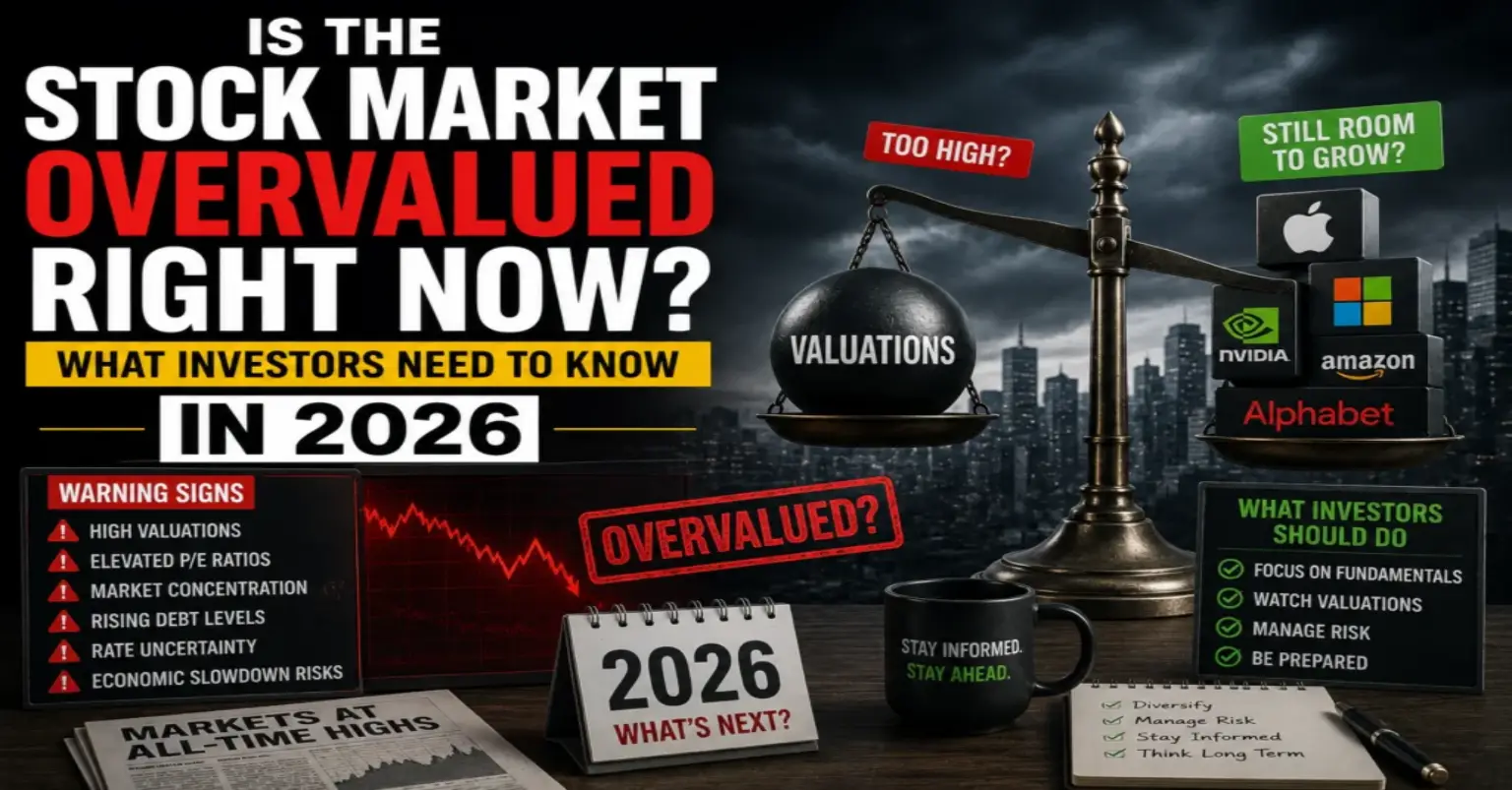
The U.S. stock market has delivered impressive gains over the past few years, driven largely by artificial intelligence, technology innovation, and resilient corporate earnings. If you’re new to investing, you may also want to read our guide on How to Start Investing in the Stock Market in 2026 before evaluating current market conditions.
With major indexes trading near record highs in 2026, a growing number of investors are asking an important question:
Is the stock market overvalued right now?
It’s a reasonable concern.
Whenever stock prices rise significantly, investors naturally wonder whether the market is running ahead of reality—or if there’s still room for further growth.
The answer isn’t as simple as “yes” or “no.”
To understand whether the stock market is overvalued in 2026, investors need to look beyond headlines and examine the key indicators that professionals use to evaluate market valuations.
Investors can also explore the basics of stock valuation through Investor.gov.
What Does “Overvalued” Actually Mean?
A stock market is considered overvalued when stock prices rise faster than the underlying earnings and economic fundamentals that support them.
In simple terms:
- If company profits are growing alongside stock prices, higher valuations may be justified.
- If stock prices rise much faster than earnings growth, investors may be paying too much for future expectations.
Overvaluation doesn’t automatically mean a market crash is coming.
However, it can increase the risk of volatility and lower future returns.
Why Investors Are Talking About Valuations in 2026
Several factors have pushed valuation concerns back into the spotlight.
These include:
- Record-high stock indexes
- Strong AI-related rallies
- Elevated price-to-earnings ratios
- Heavy concentration in large technology companies
- Continued investor optimism
Many analysts believe the market’s biggest gains have been driven by expectations of future growth rather than current earnings performance.
That doesn’t necessarily mean those expectations are wrong—but it does mean investors are paying close attention.
The Price-to-Earnings Ratio Is Rising
One of the most widely used valuation tools is the Price-to-Earnings (P/E) ratio.
The P/E ratio compares a company’s stock price to its earnings.
A higher P/E ratio generally means investors expect stronger future growth.
Throughout 2026, many high-profile technology and AI companies have traded at significantly higher valuations than the broader market.
Supporters argue that these companies deserve premium valuations because of their growth potential.
Critics argue that expectations may have become too optimistic.
The truth likely lies somewhere in between.
AI Stocks Are Driving Much of the Market
Artificial intelligence continues to be one of the biggest themes in investing.
Companies involved in:
- AI software
- Semiconductor manufacturing
- Cloud computing
- Data center infrastructure
have attracted enormous investor interest.
As a result, some AI-related stocks have experienced extraordinary gains.
The challenge is that future growth is already heavily reflected in many stock prices.
When expectations become extremely high, even strong earnings reports can disappoint investors.
This is one reason AI stocks have experienced increased volatility during 2026.
Market Concentration Is Becoming a Concern
Another issue attracting attention is market concentration.
A relatively small group of mega-cap technology companies now accounts for a large portion of major stock index performance.
This means:
- Indexes can appear strong
- Investor confidence remains high
- But many individual stocks may not be participating equally
Historically, narrow market leadership has sometimes signaled underlying weakness.
While it doesn’t guarantee a correction, it can suggest that market strength is less broad-based than headlines imply.
Interest Rates Still Matter
Valuations don’t exist in a vacuum.
Interest rates continue to play a major role in determining how investors value stocks.
When interest rates are low, investors are often willing to pay higher prices for future growth.
When rates remain elevated, future earnings become less valuable in today’s dollars.
This creates pressure on growth-oriented sectors, particularly technology stocks.
Many investors are closely monitoring Federal Reserve policy because it can significantly influence market valuations.
What History Tells Us About Expensive Markets
History shows that expensive markets can remain expensive for longer than many people expect.
Investors often assume that high valuations automatically lead to market crashes.
In reality, markets can continue rising if:
- Earnings keep growing
- Economic conditions remain stable
- Investor confidence stays strong
However, historically expensive markets often experience:
- Higher volatility
- More frequent corrections
- Lower long-term returns compared to periods when stocks are cheaper
This doesn’t mean investors should avoid stocks entirely.
It simply means expectations should remain realistic.
Reasons the Market May Not Be Overvalued
There are also strong arguments supporting current valuations.
Corporate Earnings Remain Strong
Many companies continue generating healthy profits and cash flow.
Strong earnings can justify higher stock prices.
AI Could Drive Long-Term Growth
Artificial intelligence may significantly improve productivity across multiple industries.
If these expectations prove accurate, today’s valuations may eventually look reasonable.
The U.S. Economy Remains Resilient
Despite concerns about inflation and interest rates, economic activity has remained stronger than many analysts expected.
A healthy economy supports corporate earnings growth.
Innovation Continues
Technological innovation has historically created substantial long-term shareholder value.
Many investors believe current AI developments represent another major innovation cycle.
What Smart Investors Are Doing Right Now
Rather than trying to predict exactly when the market will rise or fall, experienced investors are focusing on fundamentals.
Many are:
- Diversifying portfolios
- Avoiding excessive concentration
- Investing consistently
- Maintaining long-term perspectives
- Reviewing risk tolerance
These strategies often prove more effective than attempting to time market tops and bottoms.
Should You Wait for a Market Crash?
Many investors postpone investing because they expect a correction.
While market pullbacks are normal, waiting for the perfect entry point can be risky.
Historically, missing the market’s strongest days has significantly reduced long-term returns.
Instead of trying to predict the next correction, many investors use strategies such as:
- Dollar-cost averaging
- Regular monthly investing
- Long-term portfolio building
These approaches help reduce the impact of short-term market fluctuations.
The Bottom Line
So, is the stock market overvalued right now?
In some areas—particularly certain AI and technology stocks—valuations appear elevated compared to historical averages.
However, strong corporate earnings, continued innovation, and economic resilience provide reasons why investors remain optimistic.
The reality is that no single indicator can determine whether the entire stock market is overvalued.
What investors should focus on is maintaining a diversified portfolio, managing risk, and avoiding emotional decisions driven by market headlines.
Markets may be expensive, but history shows that long-term wealth is often built by staying invested—not by trying to perfectly predict the next correction.