 MOHAMMAD ABUBAKR
Maria hadn’t missed a credit card payment in over a decade. She paid her rent on time, kept a small emergency fund, and checked her bank balance every Sunday night like clockwork. But her student loans were a different story.
When her bill jumped back into her budget after years of pandemic-era pauses, she figured she’d “catch up next month.” Next month became three months. Then six. She stopped opening the emails from her loan servicer altogether, assuming they were just reminders she already knew about.
Nine months later, Maria checked her credit score before applying for a car loan. It had dropped more than 90 points. Her loan was officially in default, and a notation that would follow her for years had just landed on her credit report.
Maria isn’t alone. According to data from the Federal Reserve Bank of New York, roughly 1 million federal student loan borrowers defaulted during the fourth quarter of 2025, with an additional 2.6 million borrowers defaulting during the first quarter of 2026. That brings the total number of borrowers in default to roughly 7.7 million people, and researchers warn a second wave could still be coming.
If you have federal student loans and you’ve been putting off dealing with them, this is the moment to pay attention. This article breaks down exactly what happened, what default actually does to your finances, and — most importantly — what you can do right now to protect your credit before it’s too late.
Note: This article explains general facts about federal student loan default. It is not financial or legal advice. Your specific situation may differ, and you should talk to your loan servicer or a qualified professional before making decisions.
What Happened? Why Millions of Borrowers Defaulted at Once

To understand why so many people defaulted around the same time, you have to go back to 2020.
When the COVID-19 pandemic hit, the federal government paused payments and interest on federal student loans. That pause, originally meant to last a few months, stretched on for more than three years. For most of that time, borrowers weren’t required to pay anything, and nothing showed up as late on their credit reports.
When payments restarted in October 2023, the Department of Education added a cushion called the “on-ramp” period. During this stretch, which lasted until October 2024, missed payments still weren’t reported to the credit bureaus. In other words, borrowers had years where being late had no visible consequence.
That all changed once the on-ramp ended. The first new student loan delinquencies began showing up on credit reports again in early 2025, and since then, more than 17 percent of student loan borrowers have fallen at least 90 days behind on payments at least once.
Here’s the part that catches a lot of people off guard: federal law defines default as being 270 days past due — that’s roughly nine months of missed payments. Because of how the timeline lined up, the fourth quarter of 2025 was the first time new defaults started appearing on credit reports since the pandemic began.
So why did it spike so fast?
- Years without practice making payments. Many borrowers had gone three-plus years without budgeting for a student loan bill. When it returned, it competed with rent, groceries, and other bills that had also gotten more expensive.
- A widespread sense that “nothing happens” if you’re late. The on-ramp period trained some borrowers to believe missed payments were low-risk, right up until it ended.
- Confusion around repayment plans. Millions of borrowers had been enrolled in the Saving on a Valuable Education (SAVE) plan, which was later struck down by a federal appeals court. Many of those borrowers were excused from payments since the summer of 2024 and are only now being pushed back into repayment, and researchers expect a “second wave” of defaults as they hit the nine-month mark.
This isn’t just a story about irresponsible borrowers. It’s a story about a system restart that caught millions of people off guard, often through no fault of their own beyond simple bad timing.
What Happens When You Default on a Student Loan?
Default isn’t a single event — it triggers a chain reaction across several parts of your financial life. Here’s what changes, one piece at a time.
Credit Score Damage
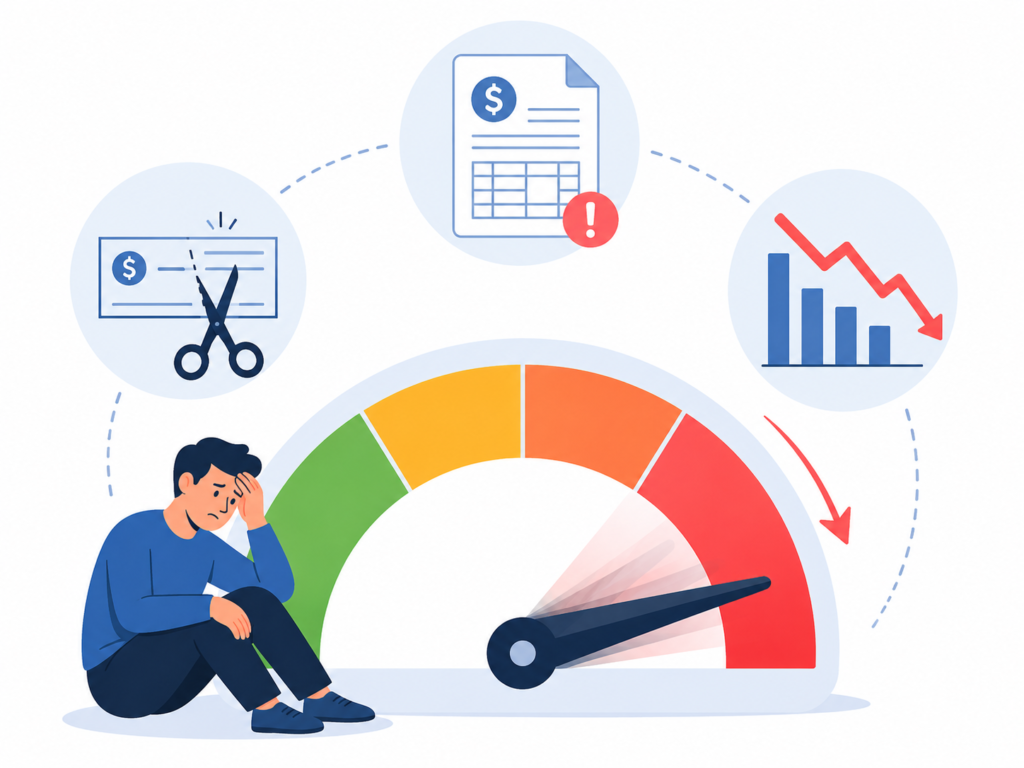
This is usually the first thing people notice, and it can be brutal. According to New York Fed data, average credit scores for defaulted borrowers dropped 91 points between the third quarter of 2024 and the fourth quarter of 2025 — falling from 567 to 476 on the Equifax Risk Score scale.
Once a default shows up on your credit report, it typically stays there for seven years, even after the loan is eventually paid off or resolved. During that time, lenders see you as a higher risk, which means:
- Higher interest rates on any credit card, auto loan, or mortgage you do qualify for
- Lower credit limits
- Outright denials for loans, apartments, or certain jobs that check credit
Think of your credit score as a kind of financial reputation. A default doesn’t just dent it — it puts a long-term asterisk next to your name that other lenders will see for years.
Wage Garnishment
Federal student loans come with collection powers that most other types of debt don’t have. Once a loan is in default, the government can order your employer to withhold a portion of your paycheck without first suing you in court — a process called administrative wage garnishment.
As of mid-2026, this is a moving target. The Department of Education began sending wage garnishment notices to a small number of defaulted borrowers in January 2026, with plans to expand each month. However, the Department later announced it would delay implementing involuntary collections, including administrative wage garnishment and the Treasury Offset Program, to give itself time to roll out new student loan repayment reforms.
That means garnishment is currently paused — but it is not canceled, and the Department has signaled it intends to resume enforcement once the new repayment system is in place. If your loan is in default, garnishment is a real possibility on the horizon, not a hypothetical.
Tax Refund Offsets
The same collection authority that allows wage garnishment also allows the government to intercept your federal tax refund — and even Social Security retirement or disability benefits — and apply them toward your defaulted loan balance through the Treasury Offset Program. Like wage garnishment, this collection tool is currently paused as the Department reworks its repayment system, but it remains available to the government going forward.
Collection Costs
Defaulted federal loans can also come with added collection costs, which get tacked onto your balance — meaning you can end up owing more than you originally borrowed. Beyond the dollar amount, default can also mean losing access to options that were available to you in good standing, like deferment, forbearance, or many income-driven repayment plans, until you resolve the default.
7 Warning Signs You’re Heading Toward Default
Default rarely happens overnight. It’s usually the end of a slow slide that started months earlier. Here are seven signs worth watching for in your own life.
1. Missing Monthly Payments
Why it matters: A single missed payment becomes delinquency, not default — but delinquency is the on-ramp to default if it continues. Federal loans typically aren’t reported as seriously delinquent until you’re at least 90 days late, but the clock toward default (270 days) starts from your first missed payment.
Real-life example: Someone misses one payment during a tight month, assumes they’ll “double up” the next month, then gets busy and forgets. Three months pass before they even check their account.
Practical solution: Set a calendar reminder the day your payment posts each month, even if you’re on autopay, so you notice immediately if something goes wrong.
2. Ignoring Loan Servicer Emails and Calls
Why it matters: Servicers often reach out before a payment is even late, offering plans that could lower your bill. Ignoring them doesn’t make the loan disappear — it just means you miss your chance to act early.
Real-life example: A borrower assumes servicer emails are spam or generic reminders and deletes them without reading. They miss an email explaining a new income-driven repayment option that would have cut their bill in half.
Practical solution: Whitelist your servicer’s email address and open every message, even briefly. If a call comes from an unfamiliar number, call your servicer back directly using the number on their official website.
3. Using Credit Cards to Cover Basic Bills
Why it matters: Relying on credit for groceries or utilities is often a sign that your monthly cash flow can’t support your obligations, including your student loan. It also adds high-interest debt on top of an already strained budget.
Real-life example: Someone puts their electric bill on a credit card “just this once” because their student loan payment came out first. The pattern repeats for several months, and credit card balances climb alongside loan stress.
Practical solution: If you’re using credit cards for essentials more than once, treat it as a signal to revisit your full budget — including your student loan payment plan — rather than just your spending habits.
4. Living Paycheck to Paycheck
Why it matters: Without breathing room in your budget, a single unexpected expense (a car repair, a medical bill) can knock your student loan payment off track entirely.
Real-life example: A borrower’s car needs a $600 repair the same week their loan payment is due. With no cushion, the loan payment gets skipped to cover the repair.
Practical solution: Even an extra $20–$50 a month set aside specifically for loan payments can create a small buffer that prevents a single bad week from turning into a missed payment.
5. No Emergency Savings
Why it matters: Emergency savings is what stands between a temporary setback and a long-term default. Without it, any disruption to income tends to hit your loan payment first.
Real-life example: Someone’s hours get cut at work for two months. With no savings to draw from, their student loan payment is the first thing to go unpaid.
Practical solution: Start small — even $500 set aside specifically for loan emergencies can buy you time to contact your servicer and explore options before missing a payment.
6. Skipping Repayment Plan Reviews
Why it matters: Your income, family size, and expenses change over time, and so do the repayment plans available to you. A plan that made sense two years ago might not fit your life now — and a better option might be sitting unused.
Real-life example: A borrower’s income dropped after a job change, but they never revisited their repayment plan. They kept paying the old, higher amount until they simply couldn’t anymore.
Practical solution: Review your repayment plan at least once a year, or any time your income or household changes, using the Department of Education’s Loan Simulator tool.
7. Not Knowing Your Loan Status
Why it matters: You can’t fix a problem you don’t know you have. Many borrowers don’t realize they’re delinquent until they’re already deep into the process — sometimes not until they check their credit report.
Real-life example: A borrower assumes their loan is still in a pandemic-era pause because they never received a clear update, when in reality repayment had restarted months earlier.
Practical solution: Log into your account at the Department of Education’s official student aid site at least once a quarter to confirm your loan status, balance, and next payment date.
Can Default Hurt Other Financial Goals?
Yes — and the effects ripple far beyond your credit report.
- Buying a home: Mortgage lenders look closely at credit history and debt-to-income ratio. A default and the credit score drop that comes with it can mean denial, or approval only at a much higher interest rate. Nearly one-third of those currently paying off student loans say they’ve delayed buying a home because of their debt, and that share is even higher among younger borrowers.
- Renting an apartment: Many landlords and property management companies run credit checks as part of the application process. A default can make it harder to qualify for a lease, or may require a larger security deposit or a co-signer.
- Car loans: As with mortgages, a damaged credit score generally means higher interest rates on auto loans — sometimes thousands of dollars more over the life of the loan — or denial altogether.
- Insurance premiums: In states that allow credit-based insurance scoring, a lower credit score can translate into higher premiums for auto or homeowners insurance.
- Employment background checks: Some employers, particularly in finance or roles involving financial responsibility, run credit checks as part of hiring. While this varies by employer and state law, a default could come up in that process.
The common thread: default doesn’t stay contained to your student loan. It touches nearly every part of your financial life that depends on trust — and credit scores are how that trust gets measured.
How to Protect Your Credit: 10+ Actionable Tips
The good news is that default is preventable in almost every case, and even if you’re already behind, you have options. Here’s where to start.
- Contact your loan servicer immediately if you’re struggling to pay. Servicers have an interest in keeping you out of default and can often offer solutions you don’t know exist.
- Explore income-driven repayment plans if you qualify. These plans tie your monthly payment to your income, which can make a previously unaffordable bill manageable.
- Set up autopay. Many servicers offer a small interest rate discount for autopay, and it removes the risk of simply forgetting a due date.
- Build an emergency fund, even a small one. Having $500–$1,000 set aside can prevent a short-term income disruption from turning into a missed payment.
- Monitor your credit reports regularly. You’re entitled to free credit reports from all three major bureaus (Experian, Equifax, and TransUnion) through AnnualCreditReport.com, and checking them helps you catch problems early.
- Create a monthly budget that includes your loan payment as a fixed, non-negotiable line item, the same way you’d treat rent.
- Prioritize essential payments, including housing, utilities, and federal student loans, ahead of discretionary spending when money is tight.
- Don’t ignore collection notices. Even if you can’t pay in full, responding shows good faith and may open the door to a workable arrangement.
- Seek nonprofit credit counseling if needed. Organizations like the National Foundation for Credit Counseling offer free or low-cost guidance for borrowers feeling overwhelmed.
- Review your repayment options regularly, especially after any change in income, job status, or family size.
- Use loan rehabilitation if you’re already in default. Federal rules allow defaulted borrowers to rehabilitate a loan by making a set number of agreed-upon payments, which can remove the default from your credit report.
- Keep your contact information updated with your servicer so you never miss an important notice because it went to an old address or email.
Common Myths About Student Loan Default
Misinformation spreads fast, especially around something as stressful as debt. Here are seven myths worth clearing up.
Myth 1: Missing one payment means immediate default. False. Missing a payment makes you delinquent, not in default. Federal loans generally aren’t considered in default until you’re 270 days — about nine months — past due.
Myth 2: Default can never be fixed. False. Borrowers can get out of default through loan rehabilitation or consolidation, both of which can restore the loan to good standing over time.
Myth 3: Student loans disappear after several years if you just don’t pay. False. Unlike some other types of consumer debt, federal student loans generally don’t have a statute of limitations that makes them simply expire. The debt — and the consequences — can follow you indefinitely until resolved.
Myth 4: Credit damage from default lasts forever. Misleading. A default typically stays on your credit report for seven years, but its impact on your score tends to fade over time, especially if you rebuild positive credit history afterward.
Myth 5: Private and federal student loans work the same way. False. Federal loans come with unique government collection powers, like wage garnishment without a court order. Private loans generally require the lender to sue and win a judgment first.
Myth 6: If you’re in default, there’s nothing you can do until you pay the full balance. False. Options like income-driven rehabilitation plans allow you to make smaller, income-based payments to work your way out of default — you don’t need to pay the entire balance at once.
Myth 7: Checking your own credit report hurts your score. False. Checking your own report is a “soft inquiry” and has no effect on your credit score. Only hard inquiries, like applying for new credit, can cause a small, temporary dip.
Frequently Asked Questions
1. What does it mean to default on a student loan? Default means you’ve gone 270 days (about nine months) without making a required payment on a federal student loan, triggering serious collection consequences.
2. How many Americans recently defaulted on student loans? According to the Federal Reserve Bank of New York, roughly 1 million borrowers defaulted in the fourth quarter of 2025, and another 2.6 million defaulted in the first quarter of 2026.
3. How much does default lower your credit score? New York Fed data shows defaulted borrowers saw an average credit score drop of 91 points, falling from 567 to 476 on the Equifax Risk Score scale.
4. Can the government garnish my wages for student loan default? Yes, federal law allows administrative wage garnishment for defaulted federal loans, though this collection tool was paused in 2026 while the Department of Education rolls out new repayment reforms.
5. Will my tax refund be taken if I default? The government can intercept tax refunds through the Treasury Offset Program for defaulted federal loans, though this was also paused alongside wage garnishment in 2026.
6. How long does a default stay on my credit report? A default typically remains on your credit report for seven years, even after the loan is resolved.
7. Can I fix a defaulted student loan? Yes, through loan rehabilitation (making a series of agreed-upon payments) or loan consolidation, both of which can bring the loan out of default.
8. Does one missed payment mean I’m in default? No. One missed payment makes you delinquent. Default requires roughly nine months of missed payments.
9. Are private student loans affected by the same default rules? No. Private loans don’t carry the same government collection powers and generally require a lawsuit before wages can be garnished.
10. What should I do if I think I’m at risk of default? Contact your loan servicer immediately to discuss income-driven repayment plans, deferment, or forbearance options before your loan reaches default status.
Conclusion
The wave of student loan defaults sweeping the country in 2026 isn’t really about irresponsibility — it’s about a system restarting after years of pause, catching millions of people off guard in the process. But the consequences are real: damaged credit, the threat of wage garnishment and tax refund offsets, and ripple effects across your ability to buy a home, rent an apartment, or get a fair interest rate.
The single most useful thing you can do today is simply find out where you stand. Log into your federal student loan account, check your current status, and review your repayment options before a small problem becomes a seven-year mark on your credit report. If you’re already behind, reach out to your servicer now — the earlier you act, the more options you’ll have.
This article is for educational purposes only and does not constitute legal or financial advice. Student loan rules and federal policies can change; consult your loan servicer or a qualified financial or legal professional for guidance specific to your situation.