 MOHAMMAD ABUBAKR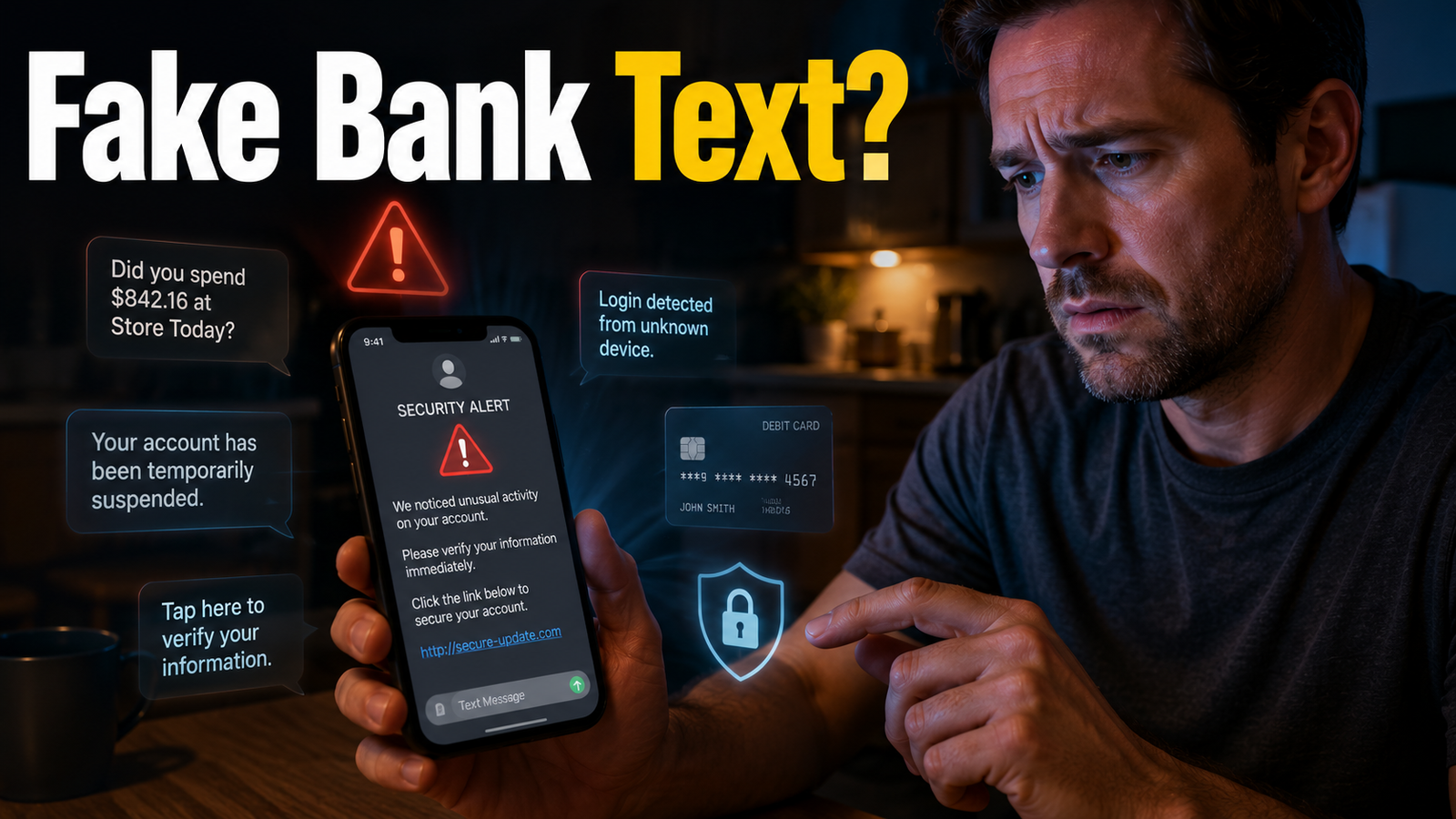
It’s 7:42 p.m. on a Tuesday. Jordan is making dinner when a text pops up: “Chase Alert: We noticed unusual activity on your account ending in 7732. Tap here to verify it was you.” The message even shows up in the same thread as old, real alerts from the bank.
Jordan pauses for a second, then taps the link. The page that loads looks exactly like the bank’s real login screen — same blue color, same logo, same layout. Jordan types in a username and password without thinking twice.
Thirty seconds later, a “verification code” request pops up. Jordan enters that too. By the next morning, $1,800 is missing from the account, and there’s no sign of a hacker breaking in from the outside. Jordan let them in.
This kind of moment is happening to people across the country every single day, and it’s getting harder to spot. Fake bank text messages used to be sloppy and easy to catch. Today, they’re polished, personalized, and built to slip past even careful, tech-savvy people. That’s exactly why understanding how these scams work — and how to recognize them in seconds — matters more now than ever.
What Is a Fake Bank Text Message?
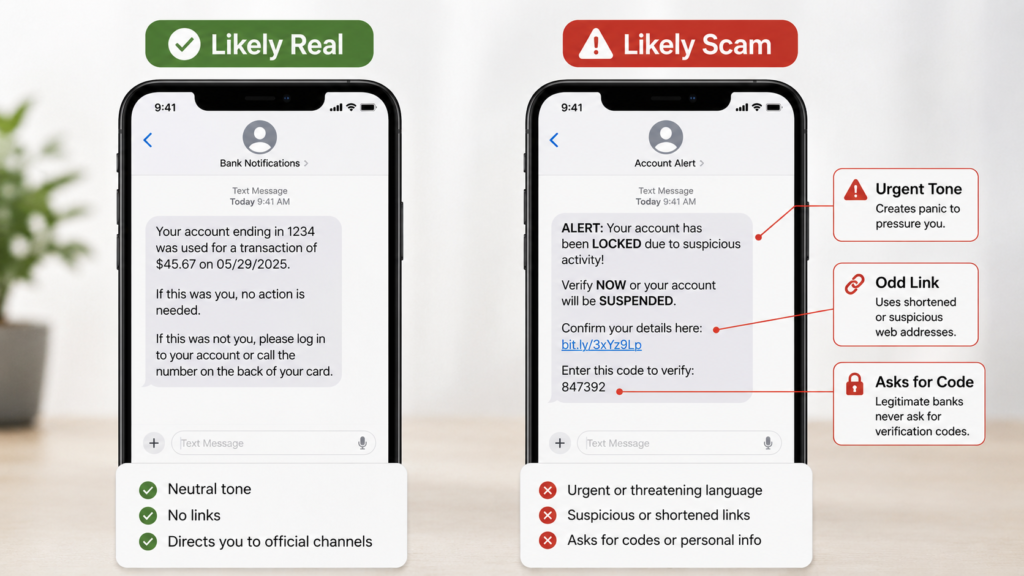
A fake bank text message is a scam text designed to look like it came from a real bank. The goal is simple: trick you into clicking a link, sharing personal information, or handing over login details that let scammers access your money.
This type of scam has a name in the cybersecurity world: smishing. It’s a mix of “SMS” and “phishing,” and it works the same way email phishing does — just through your phone’s text messages instead of your inbox.
Scammers impersonate banks because banks are something almost everyone trusts and uses. A text claiming to be from your actual bank carries instant credibility that a random stranger’s message never could. That borrowed trust is the entire foundation the scam is built on.
These messages also lean heavily on urgency. A calm message gives your brain time to think things through. A message warning that your account is locked, suspended, or under attack triggers a stress response instead, and stress makes people act first and question things later. That’s not a character flaw — it’s simply how human attention works under pressure.
It helps to remember one basic fact: legitimate banks generally avoid asking for sensitive information through text messages. They don’t usually ask you to confirm your full account number, password, or one-time code by replying to a text. When a message asks for exactly the things your real bank wouldn’t ask for, that’s a signal worth pausing on.
Real-life example: Imagine getting a text that says, “Bank of America: Your debit card is temporarily suspended due to a security issue. Confirm your identity here to reactivate: [link].” It sounds official, references your card, and creates pressure to act immediately. But a real bank typically asks you to open your secure app or call a verified number — not click a text link to “reactivate” anything.
7 Warning Signs a Bank Text Message Is Fake
Spotting a fake bank text gets much easier once you know what to look for. Here are the seven biggest warning signs.
1. Urgent Messages That Demand Immediate Action
Scam texts often include phrases like “act now,” “within 24 hours,” or “immediately” to push you into reacting before you think.
Example: “URGENT: Your account will be suspended in 1 hour unless verified.”
Scammers use urgency because panic shortens the time you spend evaluating whether something is real. The faster you act, the less likely you are to notice red flags.
What to do instead: Pause. Real account issues don’t come with countdown timers. Close the text and check your account directly through your bank’s app.
2. Suspicious Links or Shortened URLs
Many scam texts include links that look almost right but aren’t — things like “chase-secure-verify.com” instead of chase.com, or a shortened link that hides the real destination.
Example: A link reading “bnk-ofamerica.net/verify” instead of the bank’s actual website address.
Scammers use these slightly altered domains because most people skim links quickly instead of reading every character.
What to do instead: Never tap a link in an unexpected bank text. Type your bank’s website address yourself or open your banking app from your home screen.
3. Requests for Passwords, PINs, or Verification Codes
Any text asking you to share your password, PIN, or a one-time verification code is a major red flag.
Example: “Reply with the 6-digit code sent to your phone to confirm your identity.”
Scammers need this code because it’s often the last barrier protecting your account, even if they already have your password from a data breach.
What to do instead: Never share verification codes with anyone, by text, phone, or otherwise — even if the person claims to be from your bank’s fraud department.
4. Poor Grammar or Slightly Incorrect Brand Names
Some scam texts still contain awkward phrasing, while others get the bank’s name slightly wrong, like “Well Fargo” or “Bank Of-America.”
Example: “Your Wells Fargoo account has unusual activity, please verify.”
These mistakes happen because many scam campaigns are sent in bulk across multiple banks and don’t get carefully proofread.
What to do instead: Read the message closely. A misspelled brand name or oddly worded sentence is reason enough to ignore the text and verify independently.
5. Unexpected Messages About Locked Accounts
A sudden text saying your account is “locked” or “frozen,” especially when you haven’t done anything unusual, is a common scam opener.
Example: “Your checking account has been locked for your protection. Click to unlock.”
Scammers use this tactic because being locked out of your own money is genuinely alarming, which makes people skip their usual caution.
What to do instead: Log into your account directly through the app or website to check if there’s actually a problem, rather than trusting the text.
6. Requests to Confirm Personal Information
Some messages ask you to “confirm” details like your Social Security number, full card number, or date of birth.
Example: “Please confirm your card number and expiration date to restore access.”
Scammers frame this as routine “confirmation” because it sounds less alarming than directly asking you to hand over sensitive data.
What to do instead: Never send personal or financial details by text. Banks already have this information and won’t ask you to resend it this way.
7. Messages That Create Fear or Excitement to Pressure You
Beyond fake security alerts, some scam texts use the opposite emotion — excitement — like a surprise refund or reward.
Example: “You’re eligible for a $250 account credit. Claim now before it expires.”
Fear and excitement work the same way psychologically: both override careful thinking and push you toward quick action.
What to do instead: Treat unexpected financial good news with the same caution as unexpected bad news. Verify independently before doing anything.
Why These Scams Are Becoming More Convincing
Fake bank texts aren’t just more common — they’re genuinely more sophisticated than they used to be. A few trends explain why.
AI-generated scam messages. Writing tools that can generate polished, natural-sounding text are now widely available, and scammers use them too. This means the clumsy grammar that once gave scams away is becoming less reliable as a warning sign.
Caller ID and message spoofing. Technology exists that lets scammers make a text or call appear to come from a different number than it actually does. This is why a scam text can sometimes land in the same conversation thread as your bank’s real messages, making it look more trustworthy at a glance.
Personalized scam attempts. Some scam messages include a partial account number, your real name, or other specific details. This isn’t proof the bank sent it — it’s often a sign scammers obtained your information from somewhere else entirely.
Data breaches exposing personal information. Large-scale data breaches have exposed names, emails, phone numbers, and partial financial details for huge numbers of people over the years. Scammers buy and use this leaked data to make their messages feel personal and credible.
Social engineering techniques. At its core, this kind of scam isn’t really a technology problem — it’s a psychology problem. Social engineering means manipulating emotions like fear, urgency, trust, and excitement to get someone to act against their own interest, and scammers have gotten very skilled at it.
Why scammers target bank customers. Almost everyone has a bank account, which makes bank-themed scams a wide net that can catch people regardless of age, income, or background. It’s a numbers game: send enough messages, and even a small response rate can be profitable for scammers.
Understanding these trends isn’t about becoming paranoid. It’s about recognizing that the old advice — “just look for typos” — isn’t enough protection anymore on its own.
What To Do If You Receive a Suspicious Bank Text
If a questionable text lands in your phone, here’s how to handle it safely.
- Don’t click links. Even tapping a link can sometimes lead to further risks, beyond just the login page itself.
- Don’t reply to the message. Replying, even with something like “STOP,” can confirm to scammers that your number is active and being read.
- Contact your bank using the number on your bank card or official website. This is the safest way to check if there’s a real issue, since it bypasses the scam entirely.
- Report the message. Forward it to your bank’s fraud department and, in the U.S., to 7726 (SPAM), which helps carriers track scam campaigns.
- Delete the text after reporting it. Once it’s reported, there’s no reason to keep it sitting in your messages.
- Change your passwords if you accidentally interacted with the scam. If you clicked a link or entered any information, update your banking password immediately, along with any other accounts using a similar password.
- Enable multi-factor authentication where available. This adds a second layer of protection even if a password is ever compromised.
- Monitor your bank accounts and credit reports. Keep an eye out for unfamiliar transactions or new accounts you didn’t open.
- Keep your phone and banking apps updated. Updates often include security fixes that protect against newer threats.
- Share scam awareness with family members. Many scams specifically target people who may be less familiar with current tactics, so a quick heads-up can genuinely help someone you care about.
10 Smart Habits to Protect Your Bank Account
Strong habits matter more than any single piece of advice. Here are ten worth building into your routine.
- Enable account alerts so you’re notified instantly of new transactions or login attempts.
- Use strong, unique passwords for your banking accounts instead of reusing passwords across sites.
- Turn on multi-factor authentication wherever your bank offers it.
- Never share one-time verification codes, even with someone who sounds official.
- Verify unusual requests independently by contacting your bank directly rather than responding to the message.
- Review bank statements regularly to catch unfamiliar charges early.
- Keep banking apps updated to ensure you have the latest security protections.
- Freeze your credit if identity theft is suspected, which can stop new accounts from being opened in your name.
- Learn about the latest scam trends, since tactics change as scammers adapt.
- Stay calm before taking action on urgent financial messages — a few extra seconds of thought is one of the simplest protections available.
Common Myths About Bank Text Scams
Myth: Banks always text customers with clickable links. Most banks avoid sending links in security alert texts specifically because it’s hard to tell legitimate links from scam ones. When in doubt, go directly to the app instead.
Myth: A message from the bank’s name must be legitimate. Caller ID and sender names can be faked, so seeing your bank’s name on a text doesn’t confirm anything about who actually sent it.
Myth: Young people don’t fall for scams. Scam texts target people of all ages, and younger people who grew up texting frequently can be just as likely to respond quickly without checking carefully.
Myth: Scam texts are always easy to spot. Today’s scam messages can be well-written, personalized, and visually convincing, making them much harder to identify than the scams of years past.
Myth: Ignoring one scam message is enough to stay safe forever. Scammers send constant waves of new messages with different tactics, so staying safe means staying alert every time, not just once.
Myth: Only wealthy people are targeted. Scam texts are typically sent in bulk to huge numbers of phone numbers at once, regardless of the recipient’s income or account balance.
Frequently Asked Questions
What is a smishing scam? Smishing is a type of phishing scam carried out through text messages, often impersonating a trusted organization like a bank to steal personal or financial information.
How can I tell if a bank text is real? Check whether it asks for sensitive information, contains an unfamiliar link, or pressures urgent action — then verify directly through your bank’s app or official phone number rather than the text itself.
Should I click a bank verification link? No. It’s safer to go directly to your bank’s app or type the website address yourself rather than clicking a link from a text message.
What should I do if I already clicked a scam link? Avoid entering any information if you haven’t already, change your banking password immediately, contact your bank, and monitor your account closely for unusual activity.
Can scammers spoof my bank’s phone number? Yes, technology exists that allows scammers to make a message appear to come from a different number, including one that looks like your bank’s real number.
Do banks ask for passwords by text? Legitimate banks generally do not ask for passwords, PINs, or full account numbers through text messages.
Should I reply “STOP” to suspicious texts? It’s usually better not to reply at all, since responding in any way can signal to scammers that your number is active.
How do I report a scam text? In the U.S., you can forward the message to 7726 (SPAM) and report it to your bank’s fraud department and the Federal Trade Commission.
Can fake bank texts lead to identity theft? Yes, if scammers obtain enough personal information through a fake text, they may be able to use it to open accounts or commit fraud in your name.
How can I better protect my online banking account? Use strong unique passwords, enable multi-factor authentication, monitor your accounts regularly, and verify any unusual requests directly with your bank.
Final Thoughts
Fake bank text messages have changed. They’re more polished, more personalized, and more convincing than the scams of just a few years ago. But the core defense against them hasn’t changed at all: slow down before reacting to urgent financial messages.
Verify requests through your bank’s official app or phone number, not through the text itself. Share what you’ve learned here with friends and family, especially anyone who might not be as familiar with current scam tactics. Good cybersecurity habits work best alongside good financial habits, not separately from them.
A scam text only works if you act before you think. Taking just a few extra seconds to verify can be the difference between an ordinary Tuesday evening and a financial mess that takes weeks to untangle.
This article is for educational purposes only and is not intended as cybersecurity, financial, or legal advice. For guidance specific to your situation, consult your bank or a qualified professional.