 MOHAMMAD ABUBAKR
Retirement changes the way you think about investing. During your working years, the primary goal is usually to grow your wealth. Once you retire—or begin preparing for retirement—the focus often shifts toward generating reliable income while protecting the savings you’ve worked so hard to build.
Choosing the right investments for retirement income is essential because your portfolio may need to support you for 20 years or more. At the same time, inflation, market volatility, and healthcare costs can affect your purchasing power. That means retirees need a balanced approach that provides income today while allowing their investments to continue growing over time.
Fortunately, there are several investment options that can help create a dependable retirement income strategy. The best choice depends on your financial goals, risk tolerance, and expected retirement lifestyle.
Are You Saving Enough for Retirement?
This guide explores some of the best investments for retirement income in 2026 and explains how to build a diversified portfolio that supports long-term financial security.
What Makes a Good Retirement Income Investment?
Retirement investments should do more than simply generate returns.
Ideally, they should provide:
- Reliable income
- Long-term growth potential
- Diversification
- Inflation protection
- Reasonable risk management
- Easy access to funds when needed
Rather than relying on one investment, many retirees combine several income-producing assets.
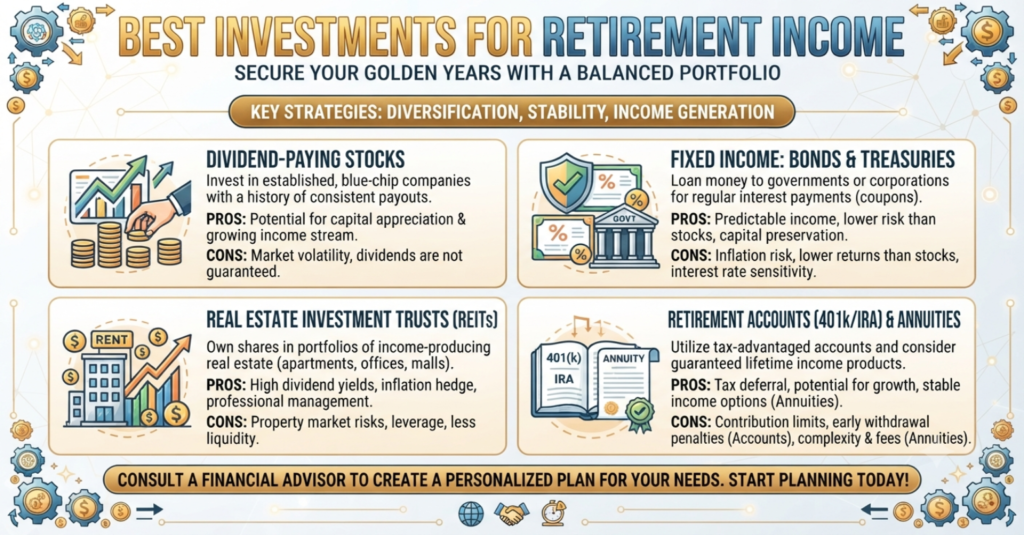
1. Dividend-Paying Stocks
Dividend-paying companies distribute a portion of their profits to shareholders.
Many established businesses have long histories of paying regular dividends.
Potential advantages include:
- Regular income
- Long-term growth potential
- Dividend increases over time
- Inflation protection
However, dividends are not guaranteed and may be reduced or suspended if a company’s financial situation changes.
2. Dividend ETFs
For investors who prefer diversification, dividend-focused Exchange-Traded Funds (ETFs) can be an attractive option.
Instead of depending on one company, dividend ETFs hold shares of many dividend-paying businesses.
Benefits include:
- Broad diversification
- Lower company-specific risk
- Regular dividend income
- Lower expense ratios than many actively managed funds
Dividend ETFs are popular among retirees seeking steady cash flow.
3. Bond Funds
Bonds have traditionally played an important role in retirement portfolios.
High-quality bond funds may provide:
- Regular interest income
- Lower volatility than stocks
- Portfolio stability
- Diversification
Although bond values can fluctuate, they often help reduce overall portfolio risk.
4. Treasury Securities
U.S. Treasury securities are backed by the federal government and are generally considered among the lowest-risk investments.
Common choices include:
- Treasury Bills (T-Bills)
- Treasury Notes
- Treasury Bonds
- Treasury Inflation-Protected Securities (TIPS)
These investments may provide dependable income while helping preserve capital.
5. Certificates of Deposit (CDs)
Certificates of Deposit offer fixed interest rates for a specified period.
Many retirees appreciate CDs because they provide:
- Predictable returns
- Principal protection (within applicable FDIC insurance limits)
- Low investment risk
However, returns may not keep pace with inflation over long periods.
6. Real Estate Investment Trusts (REITs)
REITs invest in income-producing real estate such as:
- Apartment buildings
- Office properties
- Shopping centers
- Warehouses
- Healthcare facilities
Many REITs distribute a significant portion of their income to investors.
Although REITs can produce attractive income, they may also experience market volatility.
7. Broad-Market Index Funds
Even retirees often need continued portfolio growth.
Broad-market index funds provide exposure to hundreds of companies across different industries.
Advantages include:
- Diversification
- Long-term growth potential
- Lower costs
- Reduced dependence on individual stocks
Growth investments can help offset inflation during retirement.
Why Diversification Matters
Depending entirely on one income source can increase financial risk.
A diversified retirement portfolio might include:
- Dividend ETFs
- Bond funds
- Treasury securities
- Broad-market stock funds
- Cash reserves
Diversification helps balance income generation with long-term growth.
Factors to Consider Before Choosing Investments
Your Retirement Timeline
Someone retiring next year may invest differently than someone retiring in 15 years.
Longer time horizons often allow greater exposure to growth investments.
Your Risk Tolerance
Every investor has a different comfort level with market fluctuations.
Choose investments that allow you to stay committed during both rising and falling markets.
Inflation
Inflation reduces purchasing power over time.
Including investments with long-term growth potential may help retirement income keep pace with rising costs.
Taxes
Different investments may receive different tax treatment depending on the account type and applicable laws.
Understanding tax implications can improve retirement planning.
Consider consulting a qualified tax professional for personalized advice.
Common Retirement Income Mistakes
Avoid these common errors.
Investing Too Conservatively
Keeping all retirement savings in cash may reduce long-term growth and make it harder to keep up with inflation.
A balanced portfolio often provides greater flexibility.
Chasing High Yields
Very high investment yields may come with increased risk.
Always evaluate the financial strength of the investment—not just the income it produces.
Ignoring Diversification
Relying on one company or one investment type increases portfolio risk.
Spread investments across multiple asset classes whenever appropriate.
Forgetting About Inflation
Retirement may last several decades.
Your investment strategy should account for rising living expenses.
Tips for Building Retirement Income
Consider these habits when creating your retirement portfolio.
- Diversify your investments.
- Review your portfolio annually.
- Reinvest income when appropriate before retirement.
- Keep investment costs low.
- Maintain an emergency cash reserve.
- Avoid emotional investment decisions.
- Adjust your portfolio as retirement approaches.
These habits can support greater financial stability throughout retirement.
Frequently Asked Questions
What is the safest investment for retirement income?
Many investors consider U.S. Treasury securities and insured Certificates of Deposit among the lower-risk retirement income investments. However, every investment involves some level of risk, including inflation risk.
Should retirees invest only in bonds?
Not necessarily. Many retirement portfolios include both stocks and bonds to balance income, growth potential, and risk management.
Are dividend ETFs good for retirement?
Dividend ETFs can provide regular income while offering diversification across many companies. They are a popular choice for retirement investors.
How often should I review my retirement portfolio?
Many retirees review their investments at least once or twice each year and after major life events.
Why is diversification important during retirement?
Diversification reduces dependence on any single investment and helps balance income generation with long-term portfolio growth.
Final Thoughts
The best retirement income strategy is rarely built around a single investment. Instead, successful retirees often combine dividend-paying investments, bond funds, Treasury securities, broad-market funds, and cash reserves to create a balanced portfolio. This approach can provide steady income while helping protect against market volatility and inflation.
Remember that retirement investing is about more than maximizing returns. It’s about creating reliable income that supports your lifestyle for years to come. By staying diversified, reviewing your portfolio regularly, and adjusting your strategy as your needs change, you can improve your chances of enjoying a more financially secure retirement.
Investor.gov – Retirement Toolkit