
 MOHAMMAD ABUBAKR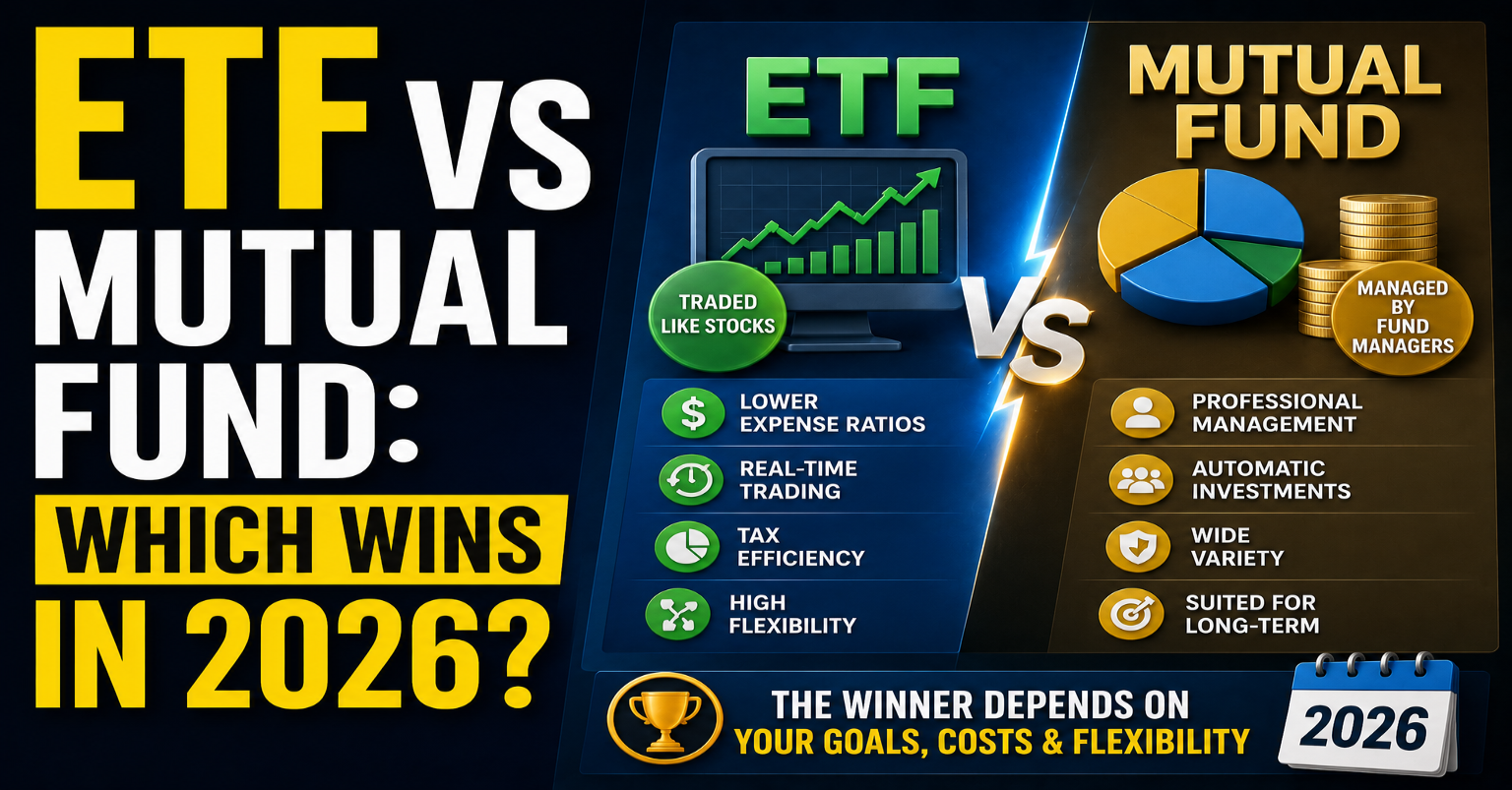
If you’re new to investing, you’ve probably heard about Exchange-Traded Funds (ETFs) and mutual funds. Both are popular investment options that allow you to own a diversified portfolio without buying individual stocks. However, many beginners struggle to decide which one is the better choice.
The answer isn’t as simple as saying one investment always beats the other. Each has unique advantages, and the right option depends on your financial goals, investing style, and time horizon. In 2026, with market volatility, changing interest rates, and growing investor interest in passive investing, understanding the differences is more important than ever.
This guide compares ETFs and mutual funds side by side, helping you choose the option that best fits your long-term investment strategy.
ETF Investing for Retirement Explained
What Is an ETF?
An Exchange-Traded Fund (ETF) is a collection of investments that trades on a stock exchange like an individual stock.
An ETF may hold:
- U.S. stocks
- International stocks
- Bonds
- Commodities
- Real estate investments
- Industry-specific companies
Because ETFs trade throughout the day, investors can buy or sell shares whenever the market is open.
What Is a Mutual Fund?
A mutual fund also pools money from many investors to purchase a diversified portfolio of assets.
Unlike ETFs, mutual funds are priced only once each trading day after the market closes.
Many mutual funds are actively managed, while others track market indexes.
The structure is different, but both investment types aim to provide diversification.
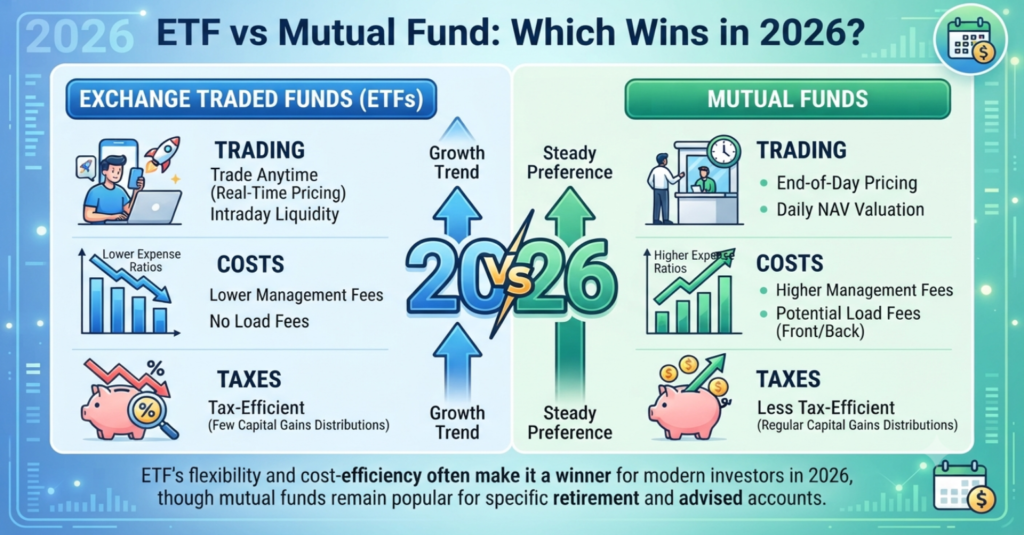
ETF vs Mutual Fund: Key Differences
1. Trading Flexibility
ETFs
ETFs trade throughout the day.
Their prices change continuously while markets are open.
Investors can place market or limit orders at any time during trading hours.
Mutual Funds
Mutual funds trade only once daily.
Every investor receives the same closing net asset value (NAV) after the market closes.
Winner: ETFs
2. Investment Costs
Investment costs directly affect long-term returns.
ETFs
Many broad-market ETFs have very low expense ratios.
They are often among the least expensive investment options available.
Mutual Funds
Index mutual funds can also have low costs.
However, actively managed mutual funds usually charge higher management fees.
Over decades, lower fees can significantly increase investment returns.
Winner: ETFs (in many cases)
3. Tax Efficiency
Taxes are another important consideration for taxable investment accounts.
ETFs
Many ETFs are considered more tax-efficient because of how shares are created and redeemed.
This structure may reduce taxable capital gain distributions.
Mutual Funds
Some mutual funds distribute capital gains to shareholders, even if investors haven’t sold their shares.
Tax outcomes depend on the specific fund and your individual situation.
Winner: ETFs (often in taxable accounts)
4. Diversification
Both investment types provide diversification.
Whether you choose an ETF or a mutual fund, one investment can offer exposure to hundreds or thousands of securities.
Winner: Tie
5. Minimum Investment
ETFs
Many brokerages allow investors to purchase as little as one share or even fractional shares.
Mutual Funds
Some mutual funds require minimum initial investments.
Others have removed minimums in recent years.
Requirements vary by provider.
Winner: ETFs
6. Automatic Investing
Mutual Funds
Many mutual funds make automatic monthly investing simple.
Regular contributions can be scheduled directly through many providers.
ETFs
Automatic ETF investing is becoming more common, but availability depends on your brokerage platform.
Winner: Mutual Funds
7. Performance
Many people assume one investment consistently outperforms the other.
In reality, performance depends on what the fund owns—not whether it’s an ETF or mutual fund.
For example:
- A U.S. stock index ETF and a U.S. stock index mutual fund tracking the same benchmark often produce very similar long-term returns.
Investment strategy matters more than fund structure.
Winner: Tie
Advantages of ETFs
ETFs continue to grow in popularity because they offer several benefits.
Advantages include:
- Low expense ratios
- Broad diversification
- Intraday trading
- Greater tax efficiency in many cases
- High transparency
- Flexible trading options
These features make ETFs attractive to many long-term investors.
Advantages of Mutual Funds
Mutual funds remain an excellent choice for many investors.
Benefits include:
- Easy automatic investing
- Professional management (for actively managed funds)
- Index fund options
- Retirement account compatibility
- Simple long-term investing
Many employer-sponsored retirement plans primarily offer mutual funds.
Which Investment Is Better for Beginners?
Both ETFs and mutual funds can work well for beginners.
ETFs may appeal to investors who want:
- Lower costs
- Trading flexibility
- Broad market exposure
- Tax efficiency
Mutual funds may suit investors who prefer:
- Automatic monthly investing
- Simplicity
- Employer retirement plans
- Hands-off investing
The best choice depends on your personal investing style.
Common Mistakes to Avoid
Regardless of which investment you choose, avoid these common errors.
Chasing Past Performance
Funds that performed well recently may not continue outperforming in the future.
Focus on long-term goals instead.
Ignoring Fees
Even small expense differences can affect long-term returns.
Always compare costs before investing.
Buying Too Many Similar Funds
Owning multiple funds with overlapping holdings may increase complexity without improving diversification.
Keep your portfolio simple.
Making Emotional Decisions
Short-term market movements should not dictate long-term investment plans.
Stay disciplined during both rising and falling markets.
Tips for Choosing Between ETFs and Mutual Funds
Before investing, ask yourself:
- Do I want intraday trading?
- Will I invest automatically every month?
- Am I investing through a retirement account?
- How important are low fees?
- Do I value tax efficiency?
Answering these questions can help you choose the investment that best fits your needs.
Frequently Asked Questions
Are ETFs better than mutual funds?
Neither is universally better. ETFs often offer lower costs and greater trading flexibility, while mutual funds may provide easier automatic investing and access through retirement plans.
Which investment has lower fees?
Broad-market ETFs generally have lower expense ratios than many actively managed mutual funds. However, low-cost index mutual funds are also available.
Are ETFs safer than mutual funds?
Both investment types carry market risk. Risk depends on the assets held inside the fund rather than whether it’s an ETF or a mutual fund.
Can I own both ETFs and mutual funds?
Yes. Many investors combine ETFs and mutual funds to create a diversified portfolio.
Which is better for long-term investing?
Both ETFs and mutual funds can support long-term investing. Consistent contributions, diversification, and low costs are often more important than the type of fund you choose.
Final Thoughts
The ETF versus mutual fund debate doesn’t have a single winner for every investor. ETFs generally stand out for their low costs, tax efficiency, and trading flexibility, making them an attractive choice for many people building long-term wealth. Mutual funds, on the other hand, remain a strong option for investors who value automatic investing, retirement plan compatibility, and a hands-off approach.
Instead of focusing only on the investment structure, pay attention to the quality of the fund, its expense ratio, diversification, and how well it aligns with your financial goals. A disciplined investment strategy, regular contributions, and patience will likely have a greater impact on your long-term success than choosing between an ETF and a mutual fund.
Investor.gov – Mutual Funds