
 MOHAMMAD ABUBAKR
Many people believe that building wealth requires taking huge risks. They assume that successful investors constantly chase hot stocks, speculative investments, or the latest financial trend. However, long-term wealth is usually built in a much different way.
In reality, many financially successful Americans focus on steady progress instead of dramatic gains. Rather than trying to double their money overnight, they make consistent financial decisions that allow their wealth to grow gradually over time. Consequently, they often experience fewer setbacks while staying on track toward their long-term goals.
Moreover, growing wealth doesn’t require predicting the next stock market winner. Instead, it involves saving regularly, investing wisely, reducing unnecessary debt, and allowing compound growth to work in your favor. Although these strategies may seem less exciting, they have helped countless people build lasting financial security.
Fortunately, you don’t have to accept excessive risk to improve your financial future. By following proven principles and remaining patient, you can grow your wealth while reducing the chances of costly financial mistakes.
Why Your Net Worth Matters More Than Your Salary
Let’s explore practical ways to build wealth while keeping risk at a comfortable level.
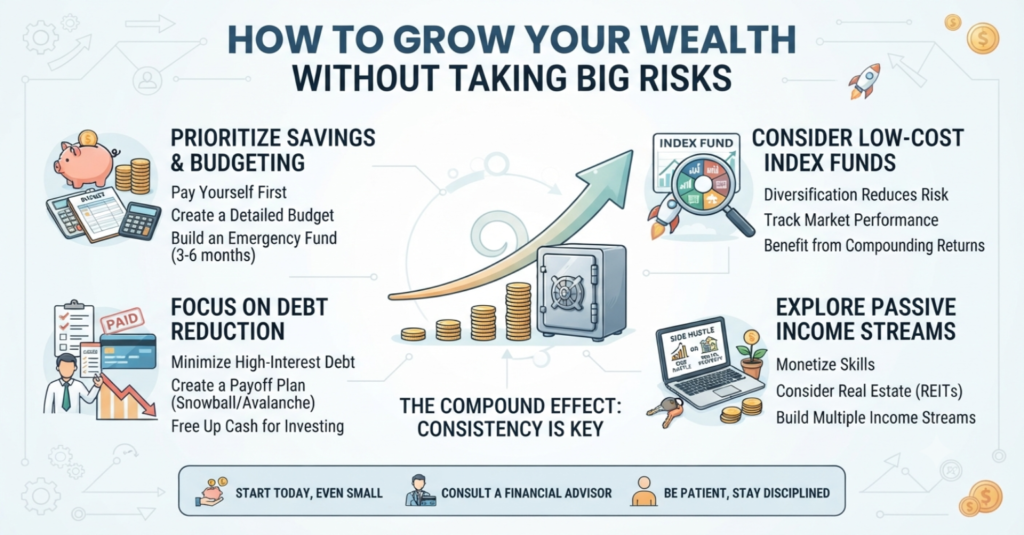
1. Build a Strong Financial Foundation First
Before focusing on investments, strengthen your financial foundation.
Without a solid base, even the best investment strategy can be disrupted by unexpected expenses.
Start by prioritizing:
- A monthly budget
- An emergency fund
- High-interest debt repayment
- Adequate insurance coverage
- Consistent savings
Furthermore, these financial habits create stability during uncertain times.
As a result, you’re less likely to sell investments during emergencies or rely on expensive borrowing.
2. Invest Consistently Instead of Timing the Market
Trying to predict short-term market movements is extremely difficult.
Therefore, many experienced investors choose consistency over market timing.
One popular strategy is dollar-cost averaging.
With this approach, you invest a fixed amount on a regular schedule regardless of whether markets are rising or falling.
Consequently, you purchase more shares when prices are lower and fewer shares when prices are higher.
Moreover, this strategy removes much of the emotion from investing.
Instead of worrying about the perfect moment to invest, you stay committed to your long-term plan.
3. Diversify Your Investments
Diversification remains one of the most effective ways to reduce investment risk.
Rather than placing all your money into one company or one type of investment, spread your investments across different assets.
A diversified portfolio may include:
- Broad-market index funds
- Exchange-Traded Funds (ETFs)
- High-quality bonds
- Dividend-paying stocks
- Cash or cash equivalents
Because different investments often perform differently, diversification may reduce the impact of poor performance in a single investment.
Although diversification doesn’t eliminate risk entirely, it can make your portfolio more resilient.
4. Focus on Long-Term Investing
Short-term market headlines can be stressful.
However, long-term investors understand that temporary market declines are a normal part of investing.
Therefore, they avoid making emotional decisions based on daily news.
Instead, they continue investing consistently while focusing on goals that may be years or even decades away.
Furthermore, long-term investing gives compound growth more time to work.
Over many years, investment returns may generate additional returns, creating a powerful wealth-building effect.
5. Increase Your Savings Rate
Growing wealth isn’t only about earning higher investment returns.
It’s also about saving more consistently.
For example, increasing your savings rate from 10% to 15% of your income may have a meaningful impact over time.
Whenever you receive:
- A raise
- A bonus
- A tax refund
- Extra freelance income
Consider directing part of that money toward savings or investments.
Rather than increasing your lifestyle immediately, use additional income to strengthen your financial future.
6. Reduce High-Interest Debt
Paying off expensive debt often provides a guaranteed financial benefit.
High-interest credit card balances, for example, can grow quickly if left unpaid.
Consequently, reducing those balances may improve your overall financial position faster than searching for higher investment returns.
Moreover, eliminating debt creates additional monthly cash flow.
That extra money can then be invested to build long-term wealth.
7. Let Compound Growth Work for You
Compound growth is one of the most powerful concepts in personal finance.
Simply put, your earnings begin generating additional earnings over time.
Although the early years may seem slow, growth often accelerates as your investments continue compounding.
Therefore, starting early can be more valuable than investing large amounts later.
Even modest monthly contributions can grow significantly over several decades.
Instead of waiting for the “perfect” time, begin with an amount you can comfortably invest and remain consistent.
8. Avoid Chasing Investment Trends
Every year brings new investment trends and exciting headlines.
Some promise extraordinary returns in a very short time.
However, chasing popular investments often increases risk.
Instead, evaluate every investment based on:
- Your financial goals
- Risk tolerance
- Time horizon
- Portfolio diversification
- Long-term strategy
Furthermore, remember that investments receiving the most attention aren’t always the best opportunities.
Successful investors usually avoid making decisions based on hype alone.
9. Keep Investment Costs Low
Many investors focus only on returns. However, investment costs also play an important role in long-term wealth building.
Even small fees can reduce your portfolio’s growth over many years.
Therefore, compare costs before choosing investment products.
Pay attention to expenses such as:
- Fund expense ratios
- Advisory fees
- Trading commissions
- Account maintenance fees
Although one fee may seem insignificant, the combined impact can become substantial over decades.
Consequently, keeping costs low allows more of your money to remain invested and continue growing.
10. Increase Your Financial Knowledge
Learning about money is one of the safest investments you can make.
Financial markets, tax rules, and retirement strategies continue evolving. Therefore, staying informed helps you make better decisions throughout your life.
Consider learning more about:
- Budgeting
- Investing
- Retirement planning
- Taxes
- Estate planning
- Credit management
Furthermore, reliable financial education helps you recognize unrealistic promises and avoid costly mistakes.
Instead of following every trend on social media, rely on trusted financial resources and long-term investing principles.
11. Review Your Financial Plan Every Year
Your financial goals may change over time.
Because of that, reviewing your financial plan annually is essential.
During your review, consider:
- Has your income changed?
- Have your expenses increased?
- Are your investments still aligned with your goals?
- Do you need to rebalance your portfolio?
- Has your emergency fund grown?
Likewise, major life events such as marriage, a new child, buying a home, or changing careers may require updates to your financial strategy.
Regular reviews help keep your plan on track without making unnecessary changes.
12. Stay Patient During Market Volatility
Market declines can make investors nervous.
Nevertheless, short-term volatility has always been part of investing.
Rather than reacting emotionally, successful investors often remain focused on their long-term objectives.
Selling investments during periods of uncertainty may lock in losses and make it harder to benefit from future recoveries.
Instead, continue following your investment plan unless your financial goals or circumstances have changed.
Patience is often one of the most valuable investing skills.
Common Mistakes That Increase Financial Risk
Avoiding unnecessary mistakes can be just as important as making smart investments.
Trying to Get Rich Quickly
Promises of guaranteed high returns should be viewed with caution.
Instead, focus on realistic strategies that emphasize steady growth over time.
Investing Without Diversification
Putting all your money into a single stock or one asset class increases risk.
Diversification helps spread that risk across different investments.
Ignoring Inflation
Money kept entirely in low-interest accounts may lose purchasing power over time.
Therefore, balance safety with long-term growth when creating your investment strategy.
Neglecting Emergency Savings
Unexpected expenses can force you to sell investments at the wrong time.
Maintaining an emergency fund provides greater financial flexibility.
Making Emotional Decisions
Fear and excitement often lead to poor investment choices.
Instead, rely on a written financial plan and review it periodically.
Daily Habits That Help Build Wealth
Growing wealth without taking big risks depends on consistent behavior rather than dramatic actions.
Consider adopting these habits:
- Save before spending.
- Invest every month.
- Review your budget regularly.
- Avoid impulse purchases.
- Pay off high-interest debt.
- Increase savings after every raise.
- Track your net worth.
- Continue learning about personal finance.
- Review your investment portfolio periodically.
- Focus on long-term financial goals.
Although these habits seem simple, they often produce meaningful results over many years.
Frequently Asked Questions
Can you build wealth without taking big investment risks?
Yes. Many people build wealth by saving consistently, investing in diversified portfolios, reducing high-interest debt, and maintaining a long-term perspective. While all investments involve some risk, these strategies aim to manage risk rather than eliminate it.
What is one of the safest ways to grow wealth?
Regular investing in a diversified portfolio, maintaining an emergency fund, and avoiding unnecessary debt are commonly used approaches for long-term wealth building. The right strategy depends on your goals and risk tolerance.
Is keeping all my money in a savings account enough?
Savings accounts are useful for emergency funds and short-term goals. However, relying only on savings may make it harder to outpace inflation over the long term.
Why is diversification important?
Diversification spreads investments across different assets. Consequently, poor performance in one investment may have less impact on your overall portfolio.
How long does it take to build wealth?
Wealth building is usually a long-term process. Consistent saving, disciplined investing, and patience often matter more than trying to achieve rapid gains.
Final Thoughts
Growing wealth doesn’t require taking unnecessary financial risks. Instead, lasting success often comes from making smart decisions consistently over many years. Saving regularly, investing in diversified assets, keeping investment costs low, reducing high-interest debt, and staying patient during market fluctuations can all strengthen your financial future.
Moreover, remember that wealth is built one decision at a time. Every dollar you save, every debt payment you make, and every thoughtful investment contributes to your long-term progress. Although the journey may seem slow at first, consistency allows compound growth to work in your favor.
Above all, focus on the habits you can control rather than chasing quick profits. By following a disciplined financial plan and reviewing it regularly, you can grow your wealth steadily while keeping risk at a level that matches your goals and comfort.
Investor.gov – Investing Basics