 MOHAMMAD ABUBAKR
Saving money sounds simple. However, sticking to a savings plan is often much harder. Unexpected expenses, rising prices, and everyday temptations can make it difficult to build a healthy savings account. Fortunately, turning saving into a challenge can make the process more enjoyable and easier to maintain.
Rather than relying on willpower alone, savings challenges encourage consistency. Moreover, they give you a clear goal to work toward while helping you develop better financial habits. Although each challenge is different, the best ones are realistic, flexible, and easy to follow.
You don’t need a high income to participate. Instead, you need a plan that fits your lifestyle and motivates you to save regularly. Consequently, even small deposits can add up to meaningful results over time.
Whether you’re building an emergency fund, saving for a vacation, or preparing for a major purchase, these savings challenges can help you stay focused and make steady progress.
Simple Budgeting Tips That Actually Work
Let’s explore savings challenges that have helped many people improve their financial habits.
1. The 52-Week Savings Challenge
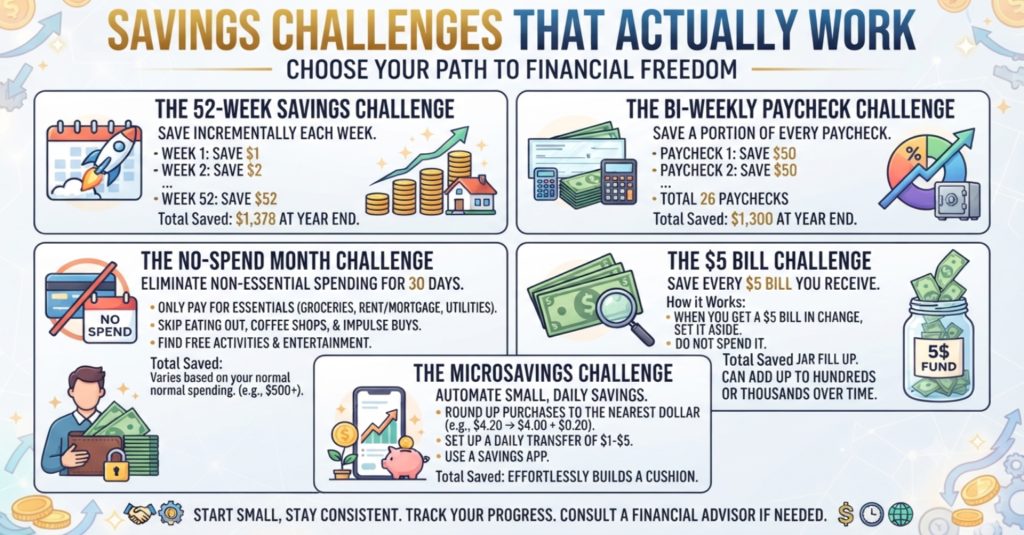
The 52-week savings challenge is one of the most popular ways to build a savings habit.
The traditional version is simple.
You save:
- $1 during Week 1
- $2 during Week 2
- $3 during Week 3
Continue increasing the amount by one dollar each week until the final week.
By the end of the year, you’ll have saved more than $1,300.
However, you can easily modify the challenge to fit your budget.
For example, start with $5 each week or reverse the challenge by saving the largest amounts earlier in the year.
As a result, you’ll create a consistent saving routine that becomes easier over time.
2. The No-Spend Challenge
Impulse purchases can quietly drain your budget.
Therefore, a no-spend challenge encourages you to avoid unnecessary spending for a specific period.
You might choose:
- One weekend
- One week
- Two weeks
- An entire month
During the challenge, only spend money on essential expenses such as:
- Rent or mortgage
- Utilities
- Groceries
- Transportation
- Healthcare
Meanwhile, avoid dining out, online shopping, entertainment purchases, and other discretionary spending.
Consequently, you’ll quickly discover how much money you can save by reducing impulse buying.
3. The Spare Change Challenge
Saving doesn’t always require large amounts.
Instead, small contributions can build momentum.
Every time you receive spare change—or notice unused cash in your wallet—set it aside.
If you primarily use debit or credit cards, round up your purchases and transfer the difference into savings.
For example:
- Spend $18.40
- Round up to $20
- Save the remaining $1.60
Although each transfer seems small, the total can grow surprisingly fast over several months.
4. The 30-Day Rule Challenge
Impulse buying is one of the biggest obstacles to saving money.
Fortunately, the 30-day rule helps reduce unnecessary spending.
Whenever you want to buy a nonessential item, wait 30 days before making the purchase.
During that time, ask yourself:
- Do I still want it?
- Do I actually need it?
- Can I find a less expensive alternative?
- Would I rather save the money?
More often than not, the urge to buy fades.
As a result, you’ll save money while becoming a more thoughtful spender.
5. The Weekly Cash Challenge
Using cash can make spending feel more intentional.
Instead of relying on cards for discretionary purchases, withdraw a fixed amount of cash each week.
Once the cash is gone, stop spending until the following week.
This method works well for categories such as:
- Dining out
- Coffee
- Entertainment
- Shopping
- Hobbies
Furthermore, seeing your cash decrease throughout the week encourages smarter purchasing decisions.
6. The Subscription Cancellation Challenge
Many households pay for subscriptions they rarely use.
Therefore, review every recurring payment.
Examples include:
- Streaming services
- Gym memberships
- Mobile apps
- Music subscriptions
- Gaming services
- Magazine memberships
Cancel anything that no longer provides value.
Then, transfer the monthly savings directly into your savings account.
Consequently, you’ll reduce waste while increasing your savings automatically.
7. The Save Every Raise Challenge
Receiving a raise is exciting.
However, many people increase their spending immediately.
Instead, challenge yourself to save part of every salary increase.
For example, save:
- 25% of every raise
- 50% of every bonus
- Your entire tax refund
- Extra freelance income
Meanwhile, continue living on your previous budget whenever possible.
Although this approach requires discipline, it can significantly accelerate your financial progress.
8. The Pantry Challenge
Food waste can quietly increase grocery expenses.
Therefore, challenge yourself to prepare meals using ingredients you already have before buying more groceries.
Check your:
- Pantry
- Refrigerator
- Freezer
Then, plan meals around those items.
As a result, you’ll reduce food waste while lowering your grocery bill.
Moreover, this challenge often inspires creative meal planning and healthier spending habits.
9. The Weather Savings Challenge
This challenge is both simple and fun.
Choose a weather-related rule that determines how much you’ll save. For example, save $5 every time it rains or $10 whenever the weekend forecast is sunny.
Alternatively, you could save an amount that matches the day’s highest temperature once each week. The exact rule doesn’t matter as much as staying consistent.
Furthermore, this challenge adds an element of surprise. Consequently, saving feels less like a chore and more like a game.
10. The Savings Jar Challenge
A savings jar remains one of the easiest ways to build better habits.
Place a jar in a visible location around your home.
Then, add money whenever you:
- Skip buying coffee.
- Cook dinner instead of eating out.
- Use a coupon.
- Receive cashback rewards.
- Find money in your pockets.
- Sell an unused item.
Although the amounts may be small, they accumulate over time.
Moreover, seeing your savings grow can provide extra motivation to continue.
11. The $5 Bill Challenge
This challenge works well if you regularly use cash.
Every time you receive a $5 bill as change, place it in your savings instead of spending it.
If you rarely carry cash, create a digital version.
For instance, transfer $5 into your savings account whenever you make a nonessential purchase.
As a result, your savings increase automatically while your spending habits become more intentional.
12. The Monthly Goal Challenge
Large financial goals often feel overwhelming.
Instead, divide your annual savings target into smaller monthly milestones.
For example:
- January: Save $250.
- February: Save $250.
- March: Save $300.
- Continue adjusting the amount as needed.
Furthermore, tracking monthly progress makes your goal feel more achievable.
If you exceed one month’s target, celebrate the success and carry that momentum into the following month.
Common Mistakes That Make Savings Challenges Fail
A savings challenge should motivate you—not create unnecessary stress.
Avoid these common mistakes to improve your chances of success.
Choosing an Unrealistic Goal
Saving too much too quickly can become discouraging.
Instead, choose a target that fits comfortably within your monthly budget.
Consistency matters more than the size of each deposit.
Forgetting to Automate Savings
Relying on memory isn’t always effective.
Therefore, schedule automatic transfers whenever possible.
Automation removes the temptation to spend money before saving it.
Not Tracking Progress
Without tracking your progress, it’s difficult to stay motivated.
Consider using:
- A budgeting app
- A spreadsheet
- A printable savings tracker
- A notebook
- Your bank’s savings tools
Watching your balance grow can reinforce positive financial habits.
Giving Up After a Setback
Unexpected expenses happen.
However, missing one week doesn’t mean the challenge has failed.
Instead, restart as soon as possible.
Long-term consistency matters much more than perfection.
Tips for Making Any Savings Challenge Successful
Although every challenge is different, these strategies can improve your results.
- Set a clear savings goal.
- Keep your money in a separate savings account.
- Celebrate small milestones.
- Reduce impulse purchases.
- Review your budget regularly.
- Save every windfall when possible.
- Stay flexible if your financial situation changes.
- Focus on progress rather than perfection.
Furthermore, sharing your challenge with a family member or friend may provide additional accountability and encouragement.
Frequently Asked Questions
Which savings challenge works best?
The best challenge is the one you can maintain consistently. Some people prefer the 52-week challenge, while others succeed with no-spend months or automatic savings plans.
Can I start a savings challenge with a small income?
Yes. Savings challenges can be adjusted to fit almost any budget. Even saving a few dollars each week helps build positive financial habits over time.
Should I keep my challenge money separate?
Yes. Using a separate savings account can reduce the temptation to spend the money before reaching your goal.
What should I save for?
Common savings goals include:
- Emergency funds
- Vacations
- Home down payments
- Holiday expenses
- New vehicles
- Home improvements
- Education costs
What if I miss a week?
Don’t quit. Instead, continue the challenge the following week or adjust your schedule if necessary. Building a consistent habit is more important than following a perfect timeline.
Final Thoughts
Saving money doesn’t have to feel difficult or restrictive. Instead, turning your financial goals into enjoyable challenges can make the process more engaging and sustainable. Whether you choose the 52-week challenge, a no-spend month, or a simple round-up strategy, each small contribution moves you closer to greater financial security.
Moreover, remember that successful saving is built on consistency rather than perfection. Even modest deposits can grow into meaningful amounts when you stay committed over time. Consequently, don’t worry about how much you save at first. Focus on creating habits that you can maintain for years to come.
Above all, choose a savings challenge that matches your lifestyle and financial goals. Stay flexible, celebrate your progress, and keep moving forward. The habits you build today can help create a stronger financial future tomorrow.
Consumer Financial Protection Bureau – Saving Money