
 MOHAMMAD ABUBAKR
Investing often feels like a game of perfect timing. Many people wait for the “best” day to buy stocks. Others try to predict the next market crash. However, history tells a different story. Time in the market almost always beats timing the market.
Successful investors rarely build wealth by making perfect predictions. Instead, they stay invested for years. They allow their money to grow through patience and compound returns.
If you want to create long-term wealth, understanding this simple idea can completely change your investment journey.
Why People Try to Time the Market
Many investors believe they can predict when prices will rise or fall. News headlines, social media, and financial experts often make this seem possible.
However, the market reacts to thousands of events every day. These include:
- Interest rate changes
- Inflation reports
- Company earnings
- Global events
- Investor emotions
As a result, predicting short-term price movements becomes extremely difficult.
Even professional fund managers struggle to do it consistently.
Therefore, individual investors often have even lower chances of succeeding.
Under Simple Tips for Long-Term Investing
What Does “Time in the Market” Mean?
Time in the market means keeping your money invested for many years instead of buying and selling frequently.
Rather than chasing short-term gains, you focus on long-term growth.
This strategy allows investments to recover from temporary market declines.
More importantly, it gives compound growth enough time to work.
The Power of Compound Growth
Compound growth is one of the strongest reasons why time beats timing.
When your investments earn returns, those returns begin earning returns too.
Imagine investing $10,000.
If it grows by an average of 10% each year, your investment does not simply increase by $1,000 annually.
Instead, every year’s gains begin creating additional gains.
Over decades, this effect becomes enormous.
That is why many wealthy investors stay invested for long periods instead of constantly trading.
Missing the Best Days Can Hurt Returns
Many investors sell during market fear.
Unfortunately, the market’s biggest recovery days often happen shortly after major declines.
If you stay out of the market, you may miss those important days.
Missing only a handful of the best-performing trading days over many years can significantly reduce total returns.
Therefore, staying invested is usually the smarter decision.
Market Crashes Are Temporary
Every investor experiences market declines.
The United States stock market has gone through recessions, financial crises, wars, pandemics, and periods of high inflation.
Despite these challenges, the market has historically recovered and continued reaching new highs over the long term.
This does not guarantee future results.
However, history clearly shows that patience has rewarded long-term investors more often than panic.
Emotional Investing Creates Mistakes
Fear and greed often control investment decisions.
When prices fall, many investors panic.
Consequently, they sell at the worst possible time.
Later, when prices recover, they buy again at much higher prices.
This emotional cycle reduces long-term returns.
Instead, successful investors follow a simple plan.
They stay disciplined.
They ignore daily market noise.
As a result, they avoid many costly mistakes.
Dollar-Cost Averaging Makes Investing Easier
Dollar-cost averaging is a popular long-term strategy.
You invest a fixed amount regularly.
For example:
- Every week
- Every month
- Every paycheck
When prices fall, your money buys more shares.
When prices rise, it buys fewer shares.
Over time, this helps reduce the impact of market volatility.
Furthermore, it removes the pressure of finding the perfect buying opportunity.
Diversification Reduces Risk
Another reason long-term investing works is diversification.
Instead of investing in only one company, spread your investments across different assets.
These may include:
- U.S. stocks
- International stocks
- Index funds
- ETFs
- Bonds
As a result, poor performance from one investment may be balanced by stronger performance from others.
Diversification cannot eliminate risk.
However, it can reduce unnecessary losses.
Real-Life Example
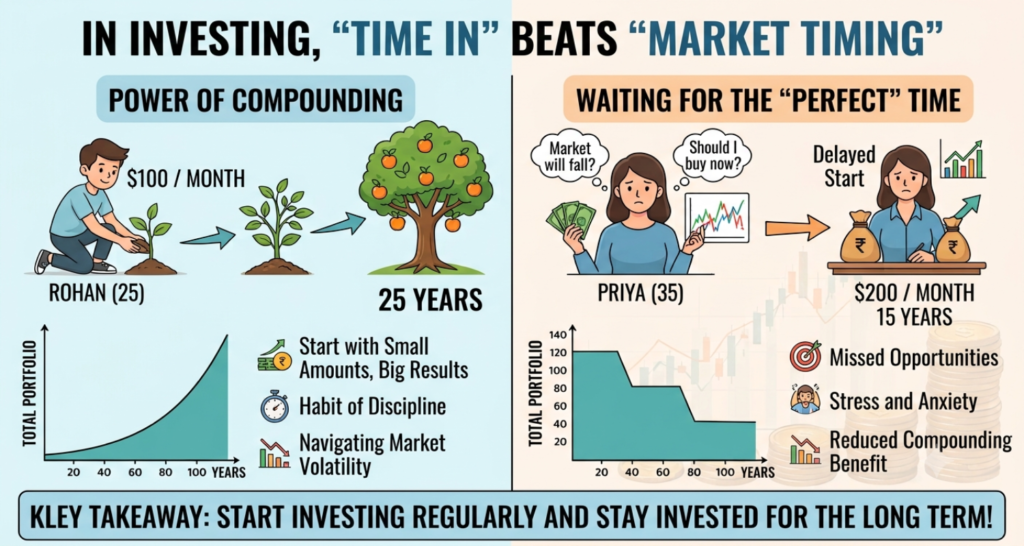
Consider two investors.
Sarah invests $500 every month for 25 years.
She ignores market headlines and continues investing during both good and bad markets.
John waits for the “perfect” time.
Sometimes he invests.
Sometimes he waits for lower prices.
Unfortunately, he often misses major market recoveries.
After 25 years, Sarah is likely to have accumulated more wealth simply because she remained invested consistently.
Her success comes from discipline rather than prediction.
Why Long-Term Investors Usually Win
Long-term investing offers several important benefits.
It helps investors:
- Benefit from compound growth
- Reduce emotional decisions
- Recover from market declines
- Lower trading costs
- Pay fewer taxes in many situations
- Build wealth steadily
Most importantly, it removes the impossible task of predicting daily market movements.
Common Mistakes to Avoid
Many new investors repeat the same errors.
Avoid these habits:
Trying to predict every market move
Nobody can consistently forecast short-term prices.
Following financial news every hour
Daily headlines often create unnecessary fear.
Selling during market corrections
Temporary declines are a normal part of investing.
Chasing hot stocks
Yesterday’s winners are not guaranteed to keep winning.
Ignoring your long-term goals
Always remember why you started investing.
Simple Tips for Long-Term Investing
Building wealth does not require complicated strategies.
Instead, focus on these habits:
- Invest consistently.
- Stay diversified.
- Reinvest dividends.
- Avoid emotional decisions.
- Review your portfolio once or twice a year.
- Keep investing during market downturns.
- Think in decades, not days.
These simple actions often outperform complicated trading strategies.
Why This Strategy Works Especially Well in the USA
The U.S. stock market has historically been one of the strongest wealth-building markets in the world.
Many successful retirement accounts, including 401(k) plans and Individual Retirement Accounts (IRAs), rely on long-term investing.
Millions of Americans build retirement savings through regular contributions instead of attempting to time market highs and lows.
Therefore, the philosophy of staying invested aligns well with successful long-term financial planning in the United States.
Final Thoughts
The greatest advantage in investing is not intelligence.
It is patience.
Nobody consistently predicts the perfect time to buy or sell.
However, anyone can stay invested with discipline.
Markets will rise.
Markets will fall.
That is normal.
The investors who succeed are usually the ones who remain focused on the future instead of reacting to every headline.
Remember this simple principle:
Time beats timing because patience allows compound growth to do the heavy lifting.
If your goal is long-term financial freedom, building wealth slowly and consistently is often the smartest investment decision you can make.