
 MOHAMMAD ABUBAKR
The business world is evolving faster than ever. Advances in technology, changing consumer expectations, economic shifts, and new workplace models are transforming how companies operate. Businesses that adapt to these changes are more likely to grow, while those that resist innovation may struggle to remain competitive.
For entrepreneurs, small business owners, and business leaders in the United States, understanding future trends is essential for making smarter decisions. Although no one can predict the future with complete certainty, several long-term trends are already influencing industries across the country.
In this guide, we’ll explore business trends that could shape the next decade, why they matter, and how businesses can prepare for long-term success.
Why Business Trends Matter
Keeping up with business trends helps companies:
- Stay competitive.
- Improve customer satisfaction.
- Increase efficiency.
- Identify new revenue opportunities.
- Reduce operational risks.
- Prepare for market changes.
Businesses that embrace innovation often adapt more quickly to changing customer needs.
How Branding Helps Small Businesses Grow
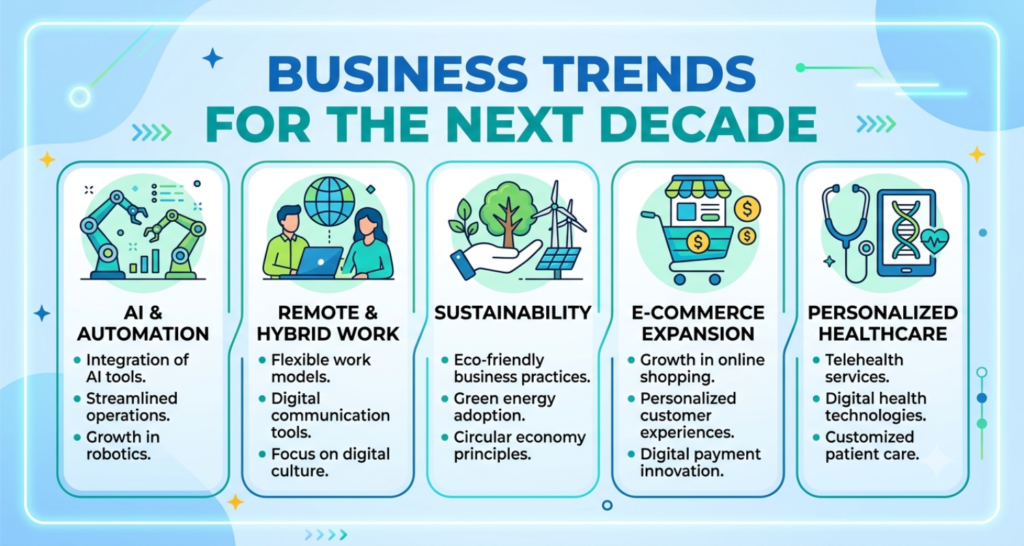
1. Artificial Intelligence Will Become a Business Essential
Artificial Intelligence (AI) is already transforming many industries.
Over the next decade, more businesses are expected to use AI for:
- Customer support.
- Data analysis.
- Marketing automation.
- Inventory management.
- Fraud detection.
- Content creation.
- Business forecasting.
Rather than replacing people entirely, AI will likely help employees work more efficiently by automating repetitive tasks.
2. Personalized Customer Experiences
Customers increasingly expect businesses to understand their preferences.
Companies are using data to provide:
- Personalized recommendations.
- Customized emails.
- Targeted promotions.
- Faster customer support.
- Tailored shopping experiences.
Businesses that deliver relevant experiences often build stronger customer loyalty.
3. Remote and Hybrid Work Will Continue
Flexible work arrangements have become common across many industries.
Many businesses now offer:
- Remote work.
- Hybrid schedules.
- Flexible hours.
- Virtual collaboration.
These models can reduce overhead costs while helping companies attract and retain talented employees.
4. Cybersecurity Will Become a Top Priority
As businesses rely more on digital systems, cybersecurity becomes increasingly important.
Companies should invest in:
- Multi-factor authentication.
- Employee security training.
- Regular software updates.
- Data encryption.
- Secure cloud storage.
- Backup systems.
Protecting customer data helps build trust and reduce financial risks.
5. Sustainability Will Influence Buying Decisions
Many consumers prefer businesses that operate responsibly.
Sustainable practices may include:
- Reducing waste.
- Using recyclable packaging.
- Improving energy efficiency.
- Supporting ethical sourcing.
- Lowering carbon emissions.
Businesses that genuinely prioritize sustainability can strengthen their reputation and attract environmentally conscious customers.
6. E-Commerce Will Continue Growing
Online shopping remains a major growth opportunity.
Successful businesses often combine:
- Physical stores.
- Online stores.
- Mobile apps.
- Social commerce.
- Multiple payment options.
An omnichannel approach allows customers to shop wherever they feel most comfortable.
7. Data-Driven Decision Making
Businesses have access to more information than ever before.
Analyzing data helps companies understand:
- Customer behavior.
- Sales trends.
- Marketing performance.
- Inventory levels.
- Employee productivity.
Using reliable data can improve decision-making and reduce costly mistakes.
8. Subscription-Based Business Models
Many businesses are shifting from one-time sales to recurring revenue models.
Examples include:
- Membership programs.
- Monthly product deliveries.
- Software subscriptions.
- Online learning platforms.
- Maintenance services.
Recurring revenue can improve cash flow and create more predictable income.
9. Digital Marketing Will Keep Evolving
Marketing continues to change as customer behavior shifts online.
Businesses should focus on:
- Search engine optimization (SEO).
- Content marketing.
- Email marketing.
- Video marketing.
- Social media engagement.
- Local search optimization.
Building trust through valuable content is likely to remain a key strategy.
10. Customer Experience Will Be a Competitive Advantage
Products alone are no longer enough.
Customers expect:
- Fast responses.
- Easy online ordering.
- Simple return policies.
- Personalized communication.
- Reliable support.
Businesses that consistently deliver exceptional experiences often gain loyal customers and positive reviews.
11. Continuous Learning and Employee Development
Technology changes quickly.
Businesses that invest in employee training can:
- Improve productivity.
- Increase innovation.
- Adapt to new tools.
- Strengthen retention.
Lifelong learning is becoming an important part of business success.
12. Financial Resilience Will Matter More
Recent economic uncertainty has highlighted the importance of strong financial management.
Businesses should focus on:
- Maintaining healthy cash flow.
- Building emergency reserves.
- Managing debt responsibly.
- Diversifying revenue sources.
- Planning for unexpected disruptions.
Financial resilience allows businesses to navigate challenging periods more effectively.
Common Mistakes Businesses Should Avoid
As industries evolve, avoid these mistakes:
- Ignoring technological changes.
- Resisting digital transformation.
- Neglecting cybersecurity.
- Overlooking customer feedback.
- Failing to train employees.
- Depending on a single revenue source.
- Ignoring financial planning.
Businesses that remain flexible are better prepared for future changes.
How to Prepare for the Next Decade
Use these strategies to stay competitive:
- Monitor industry trends regularly.
- Invest in technology wisely.
- Focus on customer satisfaction.
- Strengthen your online presence.
- Improve cybersecurity.
- Build multiple revenue streams.
- Train your employees continuously.
- Measure business performance using data.
- Develop long-term financial plans.
- Stay open to innovation.
Small improvements made consistently can produce significant long-term results.
Why Adaptability Is the Key to Success
No business trend guarantees success.
However, businesses that adapt quickly often outperform competitors.
Being willing to:
- Learn.
- Innovate.
- Improve.
- Experiment.
helps businesses respond effectively to changing customer needs and market conditions.
Adaptability is one of the most valuable competitive advantages any business can develop.
Final Thoughts
The next decade will bring exciting opportunities as well as new challenges. Artificial intelligence, digital marketing, cybersecurity, e-commerce, sustainability, and personalized customer experiences are expected to shape the future of business. While trends will continue to evolve, one principle remains constant: businesses that focus on delivering value to customers and adapting to change are more likely to succeed.
Rather than trying to adopt every new trend, identify the ones that align with your goals and customer needs. By embracing innovation thoughtfully and maintaining strong financial and operational practices, your business can remain competitive and continue growing for years to come.
National Institute of Standards and Technology (NIST) – Cybersecurity Resources:
Frequently Asked Questions
What is the biggest business trend for the next decade?
Artificial intelligence is expected to have a significant impact by improving automation, customer service, marketing, and business decision-making.
Why is customer experience becoming more important?
Customers have more choices than ever. Businesses that provide excellent service, convenience, and personalization are more likely to earn loyalty.
How can small businesses prepare for future trends?
Small businesses can invest in technology, strengthen their online presence, monitor industry developments, improve cybersecurity, and focus on customer satisfaction.
Why is financial resilience important?
Maintaining healthy cash flow, managing debt, and building emergency reserves help businesses handle economic uncertainty and continue operating during difficult periods.