 MOHAMMAD ABUBAKR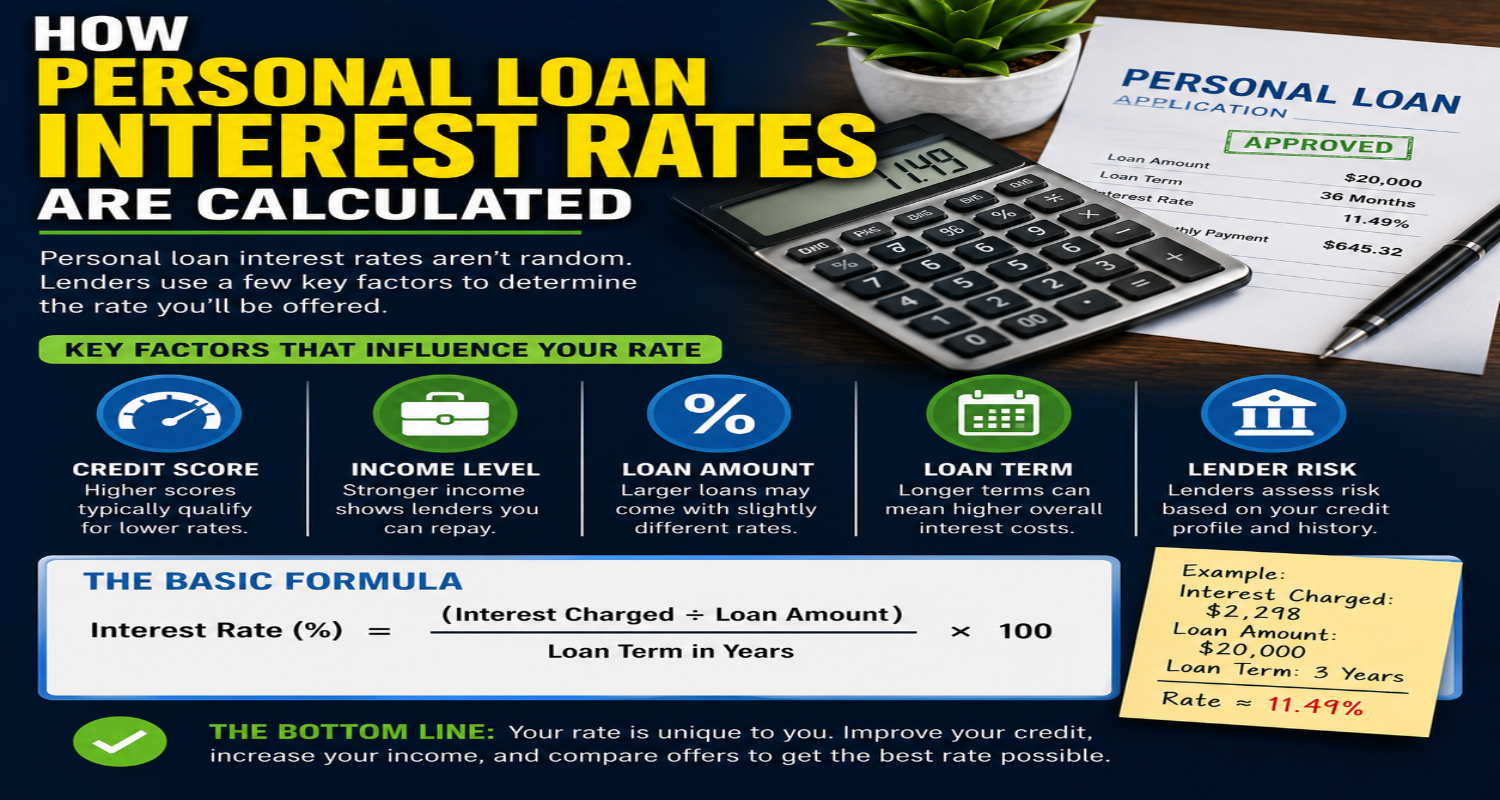
Personal loans can help you pay for unexpected expenses, consolidate debt, finance home improvements, or cover major purchases. However, before accepting a loan, it’s important to understand how personal loan interest rates are calculated.
Many borrowers assume everyone receives the same interest rate. In reality, lenders evaluate several financial factors before determining the rate you’ll pay. Your credit score, income, debt level, loan amount, and repayment term all play a role.
The better your financial profile, the more likely you are to qualify for a lower interest rate. On the other hand, borrowers with weaker credit histories may pay significantly more over the life of the loan.
This guide explains how personal loan interest rates are calculated in 2026, what affects your rate, and practical ways to reduce your borrowing costs.
What Is a Personal Loan Interest Rate?
A personal loan interest rate is the percentage a lender charges for borrowing money.
For example, if you borrow $10,000, you’ll repay:
- The original loan amount (principal)
- Interest charged over the repayment period
The interest rate determines how much borrowing will cost.
Generally, lower interest rates mean lower monthly payments and less interest paid overall.
What Lenders Really Look at Before Approving You
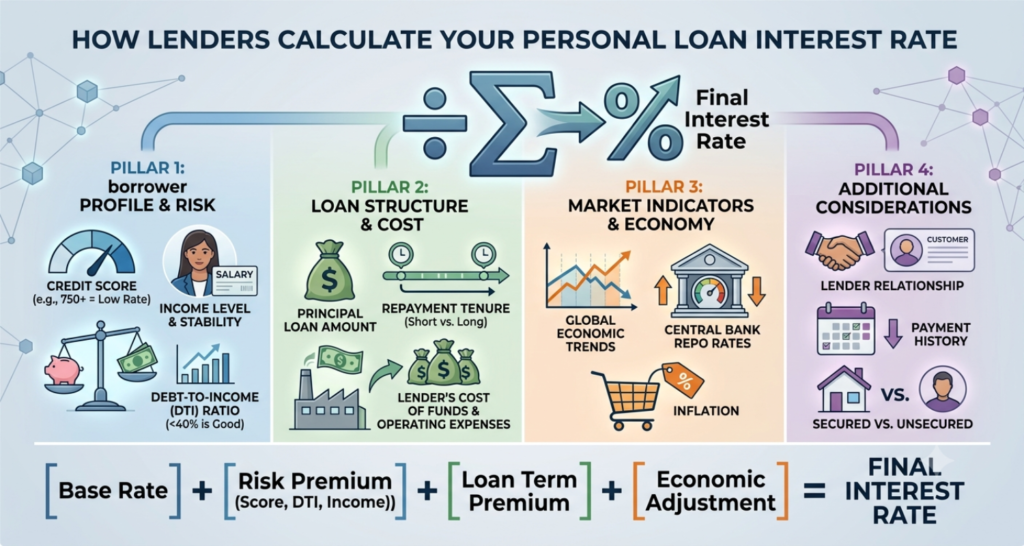
How Lenders Calculate Personal Loan Interest Rates
Every lender uses its own underwriting process. However, most consider similar financial factors.
1. Credit Score
Your credit score is one of the biggest factors.
Lenders view higher credit scores as a sign of responsible borrowing.
Generally:
- Excellent credit often qualifies for lower rates.
- Good credit may receive competitive offers.
- Fair credit usually results in moderate rates.
- Poor credit often leads to higher interest rates.
Therefore, improving your credit score before applying may reduce your borrowing costs.
2. Credit History
Lenders also examine your credit report.
They review:
- Payment history
- Late payments
- Collection accounts
- Bankruptcies
- Credit utilization
- Length of credit history
A long history of on-time payments usually improves your chances of receiving favorable loan terms.
3. Income
Your income shows whether you can comfortably repay the loan.
Lenders typically prefer borrowers with stable, reliable income.
Income may come from:
- Employment
- Self-employment
- Retirement benefits
- Other qualifying sources
Higher income alone does not guarantee the lowest rate, but it often strengthens your application.
4. Debt-to-Income Ratio (DTI)
Lenders compare your monthly debt payments with your monthly income.
This measurement is called the Debt-to-Income Ratio (DTI).
A lower DTI generally indicates that you have enough income to manage another loan.
High existing debt may increase your interest rate or reduce your approval chances.
5. Loan Amount
The amount you borrow can also influence your interest rate.
Some lenders offer better rates on larger loans.
Others reserve their lowest rates for moderate loan amounts with lower lending risk.
Policies vary by lender.
6. Loan Term
Your repayment period affects both your monthly payment and the total interest paid.
Shorter loan terms usually:
- Reduce total interest costs
- Increase monthly payments
Longer loan terms usually:
- Lower monthly payments
- Increase total interest paid
Choosing the right loan term depends on your budget and financial goals.
7. Economic Conditions
Interest rates are also influenced by broader economic factors.
These may include:
- Inflation
- Federal Reserve policy
- Market interest rates
- Overall lending conditions
Even borrowers with excellent credit may see higher rates during periods of rising interest rates.
Fixed vs. Variable Interest Rates
Most personal loans offer one of two interest rate types.
Fixed Interest Rate
A fixed rate stays the same throughout the loan.
Benefits include:
- Predictable monthly payments
- Easier budgeting
- Protection from rising market rates
Many borrowers prefer fixed-rate personal loans because they provide payment stability.
Variable Interest Rate
A variable rate can change over time.
If market rates increase:
- Monthly payments may rise.
- Total borrowing costs may increase.
If rates decrease:
- Payments could become lower.
Variable-rate loans carry more uncertainty.
Annual Percentage Rate (APR) vs. Interest Rate
Many borrowers confuse APR with the interest rate.
The interest rate reflects only the cost of borrowing money.
The Annual Percentage Rate (APR) includes:
- Interest charges
- Certain lender fees
- Origination fees (when applicable)
Because APR reflects the total borrowing cost more accurately, it is often the better number to compare when shopping for loans.
Example of Personal Loan Interest Costs
Suppose you borrow $15,000.
If one lender offers a lower interest rate than another, the difference in total repayment can be substantial over several years.
Even a small reduction in your rate may save hundreds—or even thousands—of dollars during the life of the loan.
Therefore, comparing multiple loan offers before making a decision is essential.
How to Qualify for Lower Personal Loan Interest Rates
Improving your financial profile before applying can help you secure a better rate.
Improve Your Credit Score
Pay bills on time.
Reduce outstanding balances.
Correct errors on your credit report.
Lower Your Debt
Paying down existing loans and credit cards may improve your debt-to-income ratio.
Increase Your Income
Higher verified income may strengthen your application.
Compare Multiple Lenders
Every lender uses different approval standards.
Comparing offers may help you find a lower rate.
Consider a Co-Signer
Some lenders offer lower rates when a qualified co-signer shares responsibility for the loan.
However, the co-signer becomes legally responsible if payments are missed.
Common Mistakes When Comparing Personal Loans
Avoid these common errors.
Looking Only at the Interest Rate
Always compare the APR, not just the advertised interest rate.
Choosing the Longest Loan Term
Lower monthly payments may seem attractive.
However, longer repayment periods often result in paying much more interest overall.
Applying With Multiple Lenders Without Research
Too many loan applications within a short period may create several hard inquiries.
Instead, research lenders before submitting formal applications.
Borrowing More Than Necessary
Borrow only what you actually need.
Smaller loans often reduce long-term borrowing costs.
Common Myths About Personal Loan Interest Rates
Myth: Everyone Receives the Same Interest Rate
False.
Interest rates vary based on your financial profile.
Myth: A Higher Income Guarantees the Lowest Rate
False.
Lenders evaluate many factors, including credit history and debt levels.
Myth: Fixed Rates Are Always Cheaper
False.
Variable rates may start lower, although they can increase later.
Myth: You Can’t Improve Your Interest Rate
False.
Improving your credit score, reducing debt, and comparing lenders may help you qualify for better offers.
Tips Before Applying for a Personal Loan
Before submitting an application:
- Review your credit reports.
- Check your credit score.
- Compare APRs from multiple lenders.
- Calculate your monthly budget.
- Borrow only what you need.
- Read all loan terms carefully.
- Understand any fees before signing.
Preparation helps you avoid costly borrowing mistakes.
MyCreditUnion.gov – Borrowing Basics
Final Thoughts
Personal loan interest rates are calculated using several factors, including your credit score, credit history, income, debt-to-income ratio, loan amount, repayment term, and current economic conditions. While no borrower can control market interest rates, you can improve your chances of receiving a lower rate by strengthening your financial profile before applying.
Take time to compare lenders, review APRs instead of interest rates alone, and understand the total cost of borrowing. Even a slightly lower rate can save you significant money over the life of the loan. By making informed decisions, you can choose a personal loan that fits your budget and supports your long-term financial goals.