 MOHAMMAD ABUBAKR
Buying a home is one of the biggest financial commitments most Americans will ever make. While making your monthly mortgage payment on time is essential, many homeowners wonder whether they should make extra mortgage payments to pay off their loan faster.
At first glance, paying extra toward your mortgage seems like an obvious choice. After all, eliminating debt sooner and saving thousands of dollars in interest sounds appealing. However, making additional mortgage payments is not always the best financial decision. Your overall financial situation, interest rate, investment opportunities, and future goals all play important roles.
In this guide, you’ll learn the advantages and disadvantages of making extra mortgage payments, when it makes sense, and when your money may be better used elsewhere.
What Are Extra Mortgage Payments?
An extra mortgage payment is any payment you make beyond your required monthly payment.
This extra amount usually goes directly toward your loan principal, reducing the remaining balance. Since interest is calculated based on the outstanding principal, lowering that balance helps reduce the total interest you’ll pay over the life of the loan.
Common ways homeowners make extra payments include:
- Paying an additional amount every month
- Making one extra mortgage payment each year
- Switching from monthly to biweekly payments
- Applying work bonuses or tax refunds toward the mortgage
- Making occasional lump-sum principal payments
Even small additional payments can significantly reduce your loan term.
How Rising Property Taxes Affect Homeowners
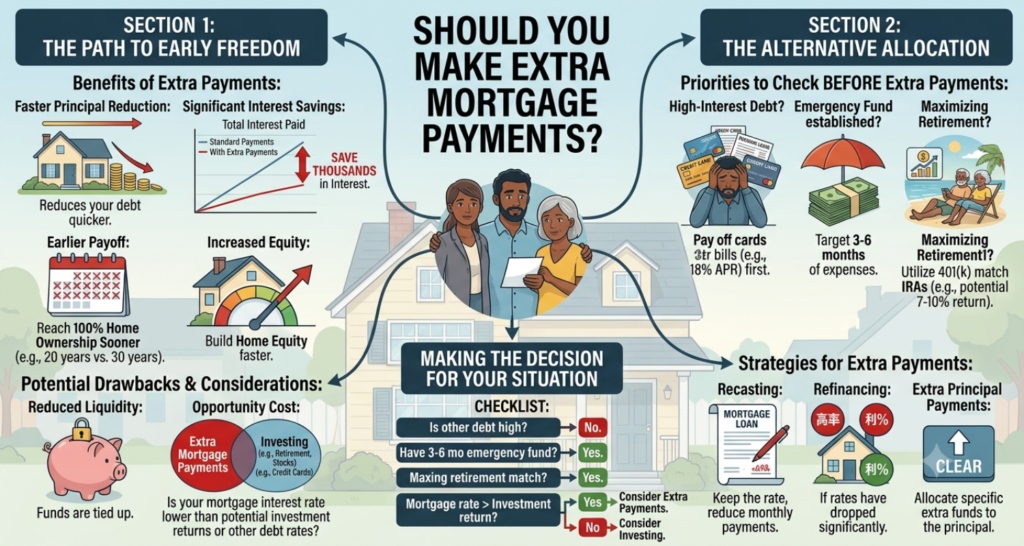
Benefits of Making Extra Mortgage Payments
1. Save Thousands in Interest
The biggest benefit is reducing the total interest paid over the life of the loan.
For example, on a $350,000 mortgage with a 30-year term, making an additional $200 per month toward the principal could save tens of thousands of dollars in interest and shorten the loan by several years, depending on your interest rate.
The earlier you begin making extra payments, the greater the savings.
2. Pay Off Your Home Faster
Extra payments reduce your principal balance more quickly.
As a result, you may pay off your mortgage years ahead of schedule.
Owning your home outright provides greater financial freedom and eliminates one of your largest monthly expenses.
3. Build Home Equity Faster
Home equity is the difference between your home’s market value and your mortgage balance.
Reducing your loan balance faster means building equity sooner.
Higher equity can:
- Improve your financial security
- Increase borrowing options if needed
- Help when refinancing
- Provide more profit if you sell your home
4. Reduce Financial Stress
Many homeowners value the peace of mind that comes from carrying less debt.
Owning your home free and clear can provide confidence during economic uncertainty or unexpected life events.
5. Improve Retirement Planning
Entering retirement without a mortgage can reduce your monthly expenses significantly.
Many financial planners encourage homeowners to reduce housing costs before retiring, especially if they expect a fixed income.
Drawbacks of Making Extra Mortgage Payments
Although paying down your mortgage offers advantages, there are situations where it may not be the smartest financial move.
1. Less Cash Available
Every extra dollar sent to your mortgage is money you cannot easily access later.
Unlike money in a savings account, home equity is relatively illiquid unless you sell your home or borrow against it.
Maintaining an emergency fund should usually take priority.
2. You May Earn Higher Returns Elsewhere
If your mortgage interest rate is relatively low, investing extra money could potentially generate higher long-term returns.
Examples include:
- Retirement accounts
- Index funds
- Brokerage accounts
- Employer-sponsored retirement plans with matching contributions
While investments carry risk, long-term market returns have historically exceeded many low mortgage rates.
3. Opportunity Cost
Every financial decision has an opportunity cost.
Using extra money to pay down your mortgage could delay other important goals such as:
- Building retirement savings
- Paying off high-interest credit cards
- Funding college education
- Starting a business
Choosing the best use of your money depends on your priorities.
4. Possible Prepayment Penalties
Most modern mortgages do not charge prepayment penalties.
However, some loans still include these fees.
Before making extra payments, review your loan agreement or contact your lender.
When Making Extra Mortgage Payments Makes Sense
Extra mortgage payments may be a smart decision if:
You Have High Mortgage Interest Rates
Higher interest rates increase borrowing costs.
Reducing the principal balance earlier can generate substantial savings.
You Already Have an Emergency Fund
Financial experts generally recommend maintaining three to six months of living expenses before making large principal payments.
This protects you from unexpected emergencies.
You Have No High-Interest Debt
If you’re carrying credit card debt with interest rates above 20%, paying that off first is usually a better financial decision.
Once expensive debt is eliminated, focusing on your mortgage becomes more attractive.
You’re Near Retirement
Reducing or eliminating mortgage payments before retirement can lower your monthly expenses and improve financial stability.
When You Might Skip Extra Mortgage Payments
Sometimes keeping extra cash available offers greater flexibility.
You may want to avoid extra payments if:
- Your mortgage interest rate is very low.
- You have little emergency savings.
- You’re eligible for employer retirement matching contributions.
- You have high-interest debt.
- You’re saving for a major purchase.
- Your income is unstable.
Biweekly Mortgage Payments
Many homeowners choose biweekly payments instead of monthly payments.
Here’s how it works:
- Instead of 12 monthly payments each year, you make half of your monthly payment every two weeks.
- Because there are 26 biweekly periods in a year, you effectively make 13 monthly payments instead of 12.
This simple strategy can shorten a 30-year mortgage by several years while reducing interest costs.
Always confirm with your lender that extra amounts are applied directly to the principal.
Should You Invest Instead?
Many homeowners compare paying down a mortgage with investing.
Paying Extra Toward Your Mortgage
Pros
- Guaranteed interest savings
- Lower debt
- Faster homeownership
- Reduced financial stress
Cons
- Lower liquidity
- Missed investment opportunities
Investing
Pros
- Potential for higher long-term returns
- Greater flexibility
- Builds retirement savings
Cons
- Investment risk
- Market volatility
- No guaranteed returns
The best option depends on your risk tolerance, financial goals, and mortgage interest rate.
Smart Strategies for Extra Mortgage Payments
If you decide to pay extra, consider these approaches:
Round Up Your Payments
Instead of paying $1,485, pay $1,600 each month.
The extra amount steadily reduces your principal.
Use Windfalls
Apply unexpected money such as:
- Tax refunds
- Bonuses
- Inheritance
- Side hustle income
toward your mortgage.
Increase Payments Annually
Whenever your income increases, consider adding a portion of your raise to your monthly mortgage payment.
Make One Extra Payment Each Year
One additional payment annually can significantly shorten your mortgage term.
Common Mistakes to Avoid
- Ignoring your emergency savings
- Paying extra while carrying high-interest debt
- Forgetting to specify that extra payments go toward the principal
- Overlooking prepayment penalties
- Neglecting retirement contributions
Final Thoughts
Making extra mortgage payments can be an excellent strategy for homeowners who want to reduce interest costs, build equity faster, and become debt-free sooner. However, it isn’t the right choice for everyone. Before sending additional money to your lender, evaluate your emergency savings, high-interest debt, retirement contributions, and investment opportunities. A balanced financial plan often delivers the greatest long-term benefit.
The right decision depends on your personal financial goals, but understanding the trade-offs will help you use your money wisely.
Consumer Financial Protection Bureau (CFPB):
Frequently Asked Questions (FAQs)
Is making extra mortgage payments always a good idea?
Not always. It can save interest, but you should first ensure you have emergency savings, no high-interest debt, and are on track with retirement investing.
Do extra mortgage payments go toward the principal?
They usually do, but you should confirm with your lender and specify that the additional amount should be applied to the principal balance.
How much can I save by paying extra?
The amount depends on your loan balance, interest rate, and how early you begin making additional payments. Even modest monthly extra payments can save thousands of dollars over the life of a mortgage.
Can I make extra payments whenever I want?
Most lenders allow additional principal payments without penalties, but you should review your mortgage agreement to check for any prepayment restrictions.