
 MOHAMMAD ABUBAKR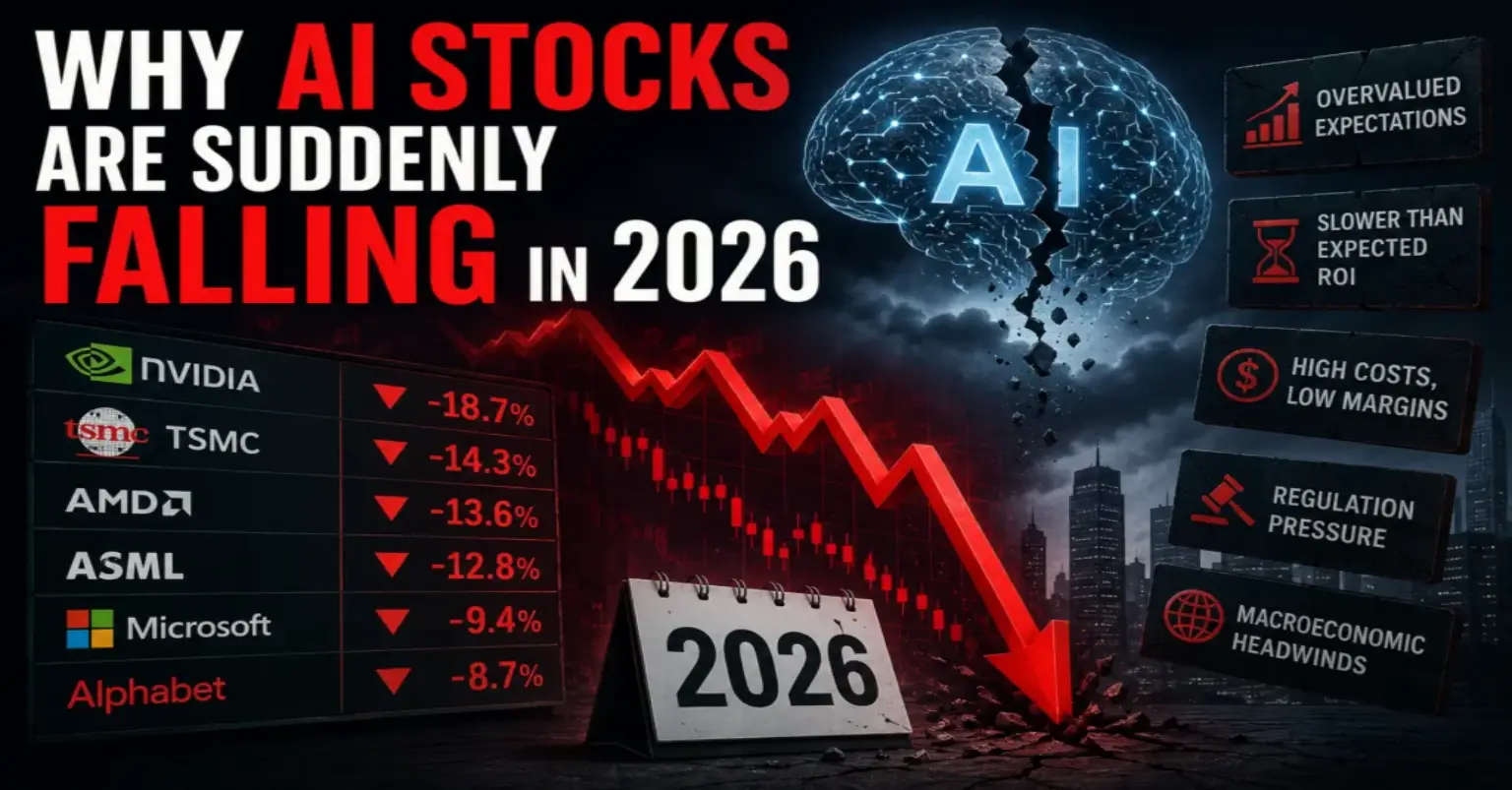
For the past few years, artificial intelligence stocks seemed unstoppable.
Companies connected to AI technology, data centers, semiconductors, cloud computing, and machine learning experienced explosive growth as investors rushed to capitalize on the AI revolution. Some stocks doubled, tripled, or even gained more in a relatively short period.
But in 2026, something unexpected happened.
Many of the market’s hottest AI stocks have suddenly started falling, leaving investors wondering whether the AI boom is over or simply taking a pause. New investors can better understand stock market fundamentals by visiting Investor.gov’s Investing Basics guide.
Periods like these often highlight some of the most common mistakes investors make during volatile markets.
If you’ve been following the stock market lately, you’ve likely noticed increased volatility among major AI-related companies. While headlines may suggest panic, the reality is far more complex.
Here’s why AI stocks are declining in 2026 and what investors should understand before making emotional decisions.
The AI Boom Created Extremely High Expectations
One of the biggest reasons AI stocks are falling is that expectations became incredibly high.
Throughout 2024 and 2025, investors poured billions into artificial intelligence companies. Wall Street analysts predicted massive future earnings, and many AI stocks reached record valuations.
Many investors entered the market without fully understanding the risks associated with concentrated investments.
The challenge?
At some point, companies must deliver results that justify those expectations.
Even when businesses report strong earnings, investors may react negatively if growth is slightly slower than anticipated.
In today’s market, good results are sometimes no longer enough. Companies are expected to produce exceptional results every quarter.
Profit-Taking Is Hitting AI Stocks
After years of strong gains, many investors are choosing to lock in profits.
This is a normal part of market cycles.
When a stock rises significantly, institutional investors, hedge funds, and individual traders often sell portions of their positions to secure gains.
As more investors take profits simultaneously, stock prices can decline even if the company’s long-term outlook remains positive.
This type of correction is common after major bull runs.
Concerns About AI Spending Are Growing
Artificial intelligence requires enormous investments.
Major technology companies continue spending billions of dollars on:
- AI infrastructure
- Advanced semiconductors
- Data centers
- Cloud computing networks
- Research and development
While investors initially welcomed these investments, some are beginning to question how quickly those expenses will generate profits.
The key concern isn’t whether AI is valuable.
The concern is whether companies can turn massive AI spending into sustainable earnings growth quickly enough to satisfy shareholders.
Valuations Reached Historically Expensive Levels
Another reason AI stocks are falling is valuation pressure.
Many AI-focused companies traded at extremely high price-to-earnings ratios during the peak of the rally.
When valuations become stretched, even minor disappointments can trigger large sell-offs.
Investors are increasingly asking:
- How much future growth is already priced in?
- Are these companies worth their current market value?
- Can earnings keep pace with stock prices?
As these questions become more common, valuations often adjust downward.
Experienced investors understand that market corrections are a normal part of long-term investing.
Rising Competition in Artificial Intelligence
The AI race has become crowded.
A few years ago, only a handful of companies dominated conversations about artificial intelligence.
Today, nearly every major technology company is investing heavily in AI.
Competition is increasing across:
- Generative AI
- Enterprise AI software
- AI chips
- Cloud services
- Automation platforms
As competition grows, profit margins may become harder to maintain.
Investors are beginning to evaluate which companies will emerge as long-term winners and which may struggle to maintain their market share.
Market Rotation Is Affecting AI Stocks
Stock market leadership rarely stays in one sector forever.
This is one reason diversification remains one of the most important investing principles.
During the AI boom, technology stocks attracted most investor attention.
In 2026, many investors are rotating capital into other sectors such as:

This shift doesn’t necessarily mean AI is failing.
Instead, it reflects investors searching for opportunities in areas that may appear undervalued compared to technology stocks.
Interest Rate Uncertainty Is Creating Pressure
Interest rates continue to influence stock market performance.
Growth stocks, including many AI companies, are particularly sensitive to interest rate expectations.
When borrowing costs remain elevated or economic uncertainty increases, investors often become less willing to pay premium valuations for future growth.
As a result, high-growth AI stocks can experience larger price swings than more established businesses.
This dynamic has contributed to increased volatility across the technology sector.
Is the AI Bubble Finally Bursting?
This is the question many investors are asking.
The answer depends on how someone defines a “bubble.”
Some individual AI stocks may have become overvalued during the excitement surrounding artificial intelligence.
However, that doesn’t necessarily mean AI itself is a temporary trend.
Most experts agree that artificial intelligence is likely to remain one of the most important technological developments of the decade.
The real question is not whether AI will transform industries.
The question is which companies will ultimately capture the largest share of that growth.
Market corrections often help separate strong businesses from weaker ones.
What Smart Investors Are Doing Right Now
Experienced investors are generally avoiding emotional reactions.
Instead of focusing on short-term stock price movements, they are evaluating:
- Revenue growth
- Profitability
- Competitive advantages
- Cash flow
- Long-term AI adoption trends
Many investors view the current decline as a normal market correction rather than the end of the AI opportunity.
Historically, innovative industries often experience periods of excitement followed by corrections before achieving long-term growth.
The internet boom, cloud computing expansion, and smartphone revolution all followed similar patterns.
Should You Buy AI Stocks During the Dip?
There is no universal answer.
Investors should consider:
Every investment decision should align with a broader financial plan and long-term goals.
- Their risk tolerance
- Investment timeline
- Portfolio diversification
- Financial goals
Buying solely because a stock has fallen can be risky.
However, some investors use market pullbacks as opportunities to accumulate shares of high-quality companies at more attractive valuations.
The focus should remain on business fundamentals rather than short-term market headlines.
The Bottom Line
AI stocks are falling in 2026 for several reasons, including profit-taking, high valuations, rising competition, concerns about AI spending, and broader market rotations.
While these declines may seem alarming, they are not unusual after a period of rapid growth.
Artificial intelligence continues to reshape industries across the economy, but investors are becoming more selective about which companies can convert AI innovation into long-term profits.
For long-term investors, the current pullback may be less about the end of the AI revolution and more about the market adjusting expectations after years of extraordinary optimism.
Investors who stay disciplined and avoid emotional decisions are often better positioned to benefit from future opportunities.
The AI story isn’t necessarily ending. It may simply be entering its next chapter.