 MOHAMMAD ABUBAKR
The way Americans manage money continues to evolve. Every year brings new challenges, fresh opportunities, and changing financial priorities. As 2027 unfolds, households across the United States are adapting to an economy shaped by technology, inflation, housing costs, and shifting consumer behavior. Consequently, financial decisions today look much different than they did just a few years ago.
Although the economy has shown resilience, many families remain cautious about spending. At the same time, investors continue looking for growth opportunities while balancing risk. Moreover, businesses are embracing innovation to improve efficiency and remain competitive. Therefore, understanding these financial trends can help you make smarter choices about saving, investing, borrowing, and planning for the future.
Rather than reacting to every headline, successful households are focusing on long-term financial habits. Likewise, they are reviewing budgets more often, reducing unnecessary expenses, and preparing for unexpected events. As a result, financial confidence is becoming just as important as financial growth.
How Americans Are Adjusting Their Spending Habits
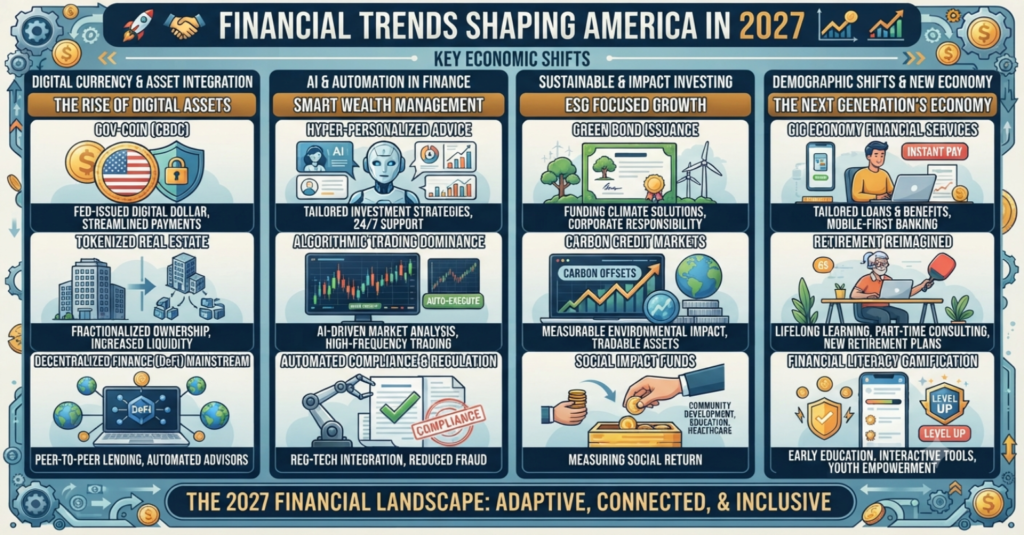
Let’s explore the biggest financial trends expected to shape America throughout 2027.
1. Smarter Consumer Spending Continues
American consumers have become much more intentional with their purchases. Instead of buying on impulse, many households now compare prices, search for discounts, and evaluate long-term value before spending money.
Furthermore, digital shopping tools make it easier to compare products across multiple retailers. Because of this, shoppers can often find better deals without spending extra time.
Many families now focus on essentials first, including:
- Housing
- Groceries
- Healthcare
- Transportation
- Utilities
- Insurance
After covering these necessities, they decide how much remains for entertainment or discretionary spending.
Meanwhile, cashback apps, loyalty programs, and coupon websites continue to gain popularity. Although each individual discount may seem small, those savings often add up over an entire year.
Consequently, smarter spending habits are becoming a permanent part of many household budgets rather than a temporary response to economic uncertainty.
2. Artificial Intelligence Is Changing Personal Finance
Artificial intelligence is no longer limited to technology companies. Instead, it has become part of everyday financial life.
For example, banks now use AI to detect fraud more quickly. Likewise, investment platforms rely on advanced algorithms to analyze market data and personalize recommendations. In addition, budgeting apps use AI-powered insights to help users monitor spending habits and identify opportunities to save money.
Businesses are also investing heavily in AI to improve productivity. As a result, companies can automate repetitive tasks while allowing employees to focus on higher-value work.
However, AI is also changing the job market. Therefore, many workers are investing in new skills to remain competitive. Learning about digital tools, automation, and data analysis may create additional career opportunities over the next several years.
Although technology continues advancing rapidly, human decision-making remains essential. AI should support financial decisions—not replace thoughtful planning.
3. Emergency Savings Are Becoming a Top Priority
Unexpected expenses can happen at any time. Because of that, more Americans are focusing on building emergency savings before increasing discretionary spending.
Financial experts often recommend setting aside several months of essential living expenses. Nevertheless, the ideal amount depends on income stability, family size, and monthly obligations.
Common emergencies include:
- Medical bills
- Job loss
- Home repairs
- Car repairs
- Major appliance replacement
- Unexpected travel
Without emergency savings, many households rely on credit cards or personal loans. Consequently, financial problems can become even more expensive due to interest charges.
On the other hand, maintaining a dedicated emergency fund provides greater flexibility during difficult situations. Even small monthly contributions can create meaningful financial security over time.
Therefore, automatic transfers into a savings account remain one of the simplest and most effective financial habits.
4. Retirement Planning Begins Earlier
Retirement planning is no longer something people postpone until their 50s or 60s. Instead, younger workers increasingly recognize the value of starting early.
The biggest advantage is compound growth. Simply put, investments have more time to generate returns when contributions begin sooner.
Many Americans now contribute regularly to:
- 401(k) plans
- Individual Retirement Accounts (IRAs)
- Roth IRAs
- Health Savings Accounts (HSAs)
- Taxable investment accounts
Furthermore, automatic payroll deductions make retirement saving easier because the money is invested before it can be spent elsewhere.
Meanwhile, financial education has become more accessible through podcasts, online courses, and educational websites. As a result, younger generations are learning about investing much earlier than previous generations.
Although retirement may seem far away, beginning today often requires much smaller monthly contributions than waiting another decade.
5. Housing Costs Continue to Shape Financial Decisions
Housing remains one of the largest expenses for most American families. Consequently, buyers and renters continue adjusting their financial plans based on changing market conditions.
Higher mortgage rates have encouraged some households to delay purchasing a home. Meanwhile, others continue renting while building larger down payments.
At the same time, homeowners face rising expenses beyond their monthly mortgage payment.
These costs may include:
- Property taxes
- Homeowners insurance
- Maintenance
- Repairs
- Utility bills
- HOA fees
Because of these ongoing expenses, many families now calculate the total cost of homeownership instead of focusing only on monthly mortgage payments.
Furthermore, affordability has become a key consideration when choosing where to live. Some buyers are exploring smaller homes or relocating to areas with lower living costs.
Rather than stretching their budgets to purchase the largest possible home, many Americans are prioritizing long-term financial flexibility.
6. Long-Term Investing Is Replacing Market Timing
Trying to predict short-term market movements has always been difficult. Therefore, many investors are focusing on strategies they can maintain for years instead of reacting to daily headlines.
Rather than chasing the latest trend, they continue investing through both rising and falling markets.
Popular long-term strategies include:
- Dollar-cost averaging
- Broad market index funds
- Exchange-Traded Funds (ETFs)
- Dividend investing
- Portfolio diversification
Furthermore, regular investing reduces the pressure to buy at the “perfect” time.
Although markets naturally experience ups and downs, history shows that disciplined investing has often rewarded patient investors over long periods.
Consequently, financial advisors frequently encourage investors to focus on their long-term goals rather than short-term market noise.
7. Digital Banking Continues to Expand
Digital banking has become a normal part of everyday life. Instead of visiting a branch for routine tasks, many Americans now manage their finances through mobile apps and online platforms.
Moreover, financial institutions continue improving their digital services. As a result, customers can transfer money, deposit checks, monitor investments, and pay bills within minutes.
Popular digital banking features include:
- Mobile check deposits
- Instant money transfers
- Budget tracking tools
- Spending alerts
- Credit score monitoring
- Automatic bill payments
Meanwhile, stronger security features, including biometric authentication and multi-factor verification, are helping protect customer accounts.
Nevertheless, consumers should remain cautious. Using strong passwords, enabling account alerts, and avoiding public Wi-Fi for financial transactions can reduce security risks.
Ultimately, digital banking saves time while giving users greater control over their finances.
8. Americans Are Working Hard to Reduce Debt
High-interest debt remains a challenge for many households. However, more Americans are making debt reduction a financial priority.
Instead of making only minimum payments, many borrowers now pay extra toward high-interest balances. Consequently, they reduce interest costs while becoming debt-free sooner.
Common debt repayment strategies include:
- The Debt Snowball Method
- The Debt Avalanche Method
- Balance transfer credit cards
- Debt consolidation loans
- Automatic monthly payments
Furthermore, many households are avoiding unnecessary borrowing altogether.
Rather than financing nonessential purchases, they are saving first and spending later.
Although paying off debt requires patience, every payment improves long-term financial health.
9. Inflation Still Influences Everyday Decisions
Inflation may not dominate headlines every day, yet its effects are still visible in household budgets.
For instance, groceries, insurance premiums, utilities, and healthcare costs remain higher than they were a few years ago.
Therefore, many families continue adjusting their spending habits.
Common responses include:
- Buying store brands
- Planning meals in advance
- Comparing insurance quotes
- Shopping during sales
- Reducing energy consumption
- Delaying unnecessary purchases
At the same time, many consumers are looking for ways to increase income through side businesses or freelance work.
Although inflation may moderate over time, careful budgeting remains an important financial habit.
10. Financial Education Is Becoming More Popular
More Americans want to understand how money works.
Instead of depending solely on financial professionals, many people are educating themselves through trusted resources.
Popular topics include:
- Investing basics
- Retirement planning
- Budgeting
- Tax strategies
- Credit scores
- Estate planning
Furthermore, employers are increasingly offering financial wellness programs.
Likewise, schools and community organizations are placing greater emphasis on personal finance education.
As a result, financial literacy continues improving across many age groups.
Better knowledge often leads to better financial decisions.
Financial Mistakes to Avoid in 2027
While financial opportunities continue growing, common mistakes can still slow progress.
Avoid these habits whenever possible.
Ignoring a Monthly Budget
Without a budget, it’s difficult to know where your money is going.
Instead, review your income and expenses regularly.
Small adjustments today can create significant savings over time.
Carrying High-Interest Credit Card Debt
Interest charges make purchases far more expensive.
Therefore, paying balances in full whenever possible should remain a priority.
If that’s not possible, paying more than the minimum can reduce interest costs.
Waiting Too Long to Invest
Many people postpone investing because they believe they need a large amount of money.
However, consistent monthly investing often matters more than trying to find the perfect time to start.
Even modest contributions can grow through compound returns over the long term.
Neglecting Emergency Savings
Unexpected expenses rarely arrive at convenient times.
Consequently, relying on credit cards during emergencies may increase financial stress.
Building an emergency fund provides greater financial flexibility.
Financial Habits That Can Help You Thrive
Building wealth rarely depends on one big decision.
Instead, consistent habits often produce the best long-term results.
Consider adopting these practices:
- Review your budget every month.
- Save before you spend.
- Invest consistently.
- Reduce unnecessary debt.
- Build an emergency fund.
- Increase retirement contributions after raises.
- Compare prices before major purchases.
- Continue learning about personal finance.
- Review insurance coverage annually.
- Reevaluate your financial goals each year.
Although these habits seem simple, they can create lasting financial stability.
Frequently Asked Questions
What are the biggest financial trends shaping America in 2027?
Major trends include smarter consumer spending, increased use of artificial intelligence, stronger retirement planning, growing emergency savings, long-term investing, digital banking expansion, and greater financial education.
Why are Americans saving more money?
Many households want greater financial security because of inflation, higher living costs, economic uncertainty, and unexpected expenses.
Is long-term investing still a good strategy?
Many financial professionals believe disciplined, diversified investing remains an effective long-term approach. However, investment decisions should always match your personal goals and risk tolerance.
How is AI affecting personal finance?
AI helps improve fraud detection, budgeting tools, investment platforms, and customer service. At the same time, it is changing the workplace by creating demand for new skills.
What financial habit has the biggest long-term impact?
Saving consistently, investing regularly, avoiding high-interest debt, and maintaining a realistic budget can all contribute to stronger financial health over time.
Final Thoughts
Financial trends will continue to evolve throughout 2027. Nevertheless, the principles of smart money management remain remarkably consistent. Americans are budgeting more carefully, reducing unnecessary debt, embracing new technology, and investing with a long-term mindset. Consequently, many households are building stronger financial foundations despite ongoing economic uncertainty.
Rather than trying to predict every market movement or economic headline, focus on the habits you can control. Save consistently, spend intentionally, invest for the future, and continue expanding your financial knowledge. Moreover, review your goals regularly so your plan evolves with your life.
Above all, remember that lasting financial success is usually built through steady progress—not overnight results. Every thoughtful financial decision you make today can help create greater confidence, flexibility, and security in the years ahead.
Consumer Financial Protection Bureau – Managing Your Money