 MOHAMMAD ABUBAKR
Introduction
The stock market has experienced major highs and difficult downturns over the past two decades.
Investors have witnessed financial crises, periods of rapid growth, rising inflation, changing interest rates, and remarkable technological innovation.
Although every market cycle is different, many investing principles remain unchanged.
Learning from the past can help you make smarter financial decisions in the future.
In this guide, you’ll discover valuable investing lessons from the last 20 years and learn practical habits that may help you become a more confident long-term investor.
Why Looking Back Matters
No one can predict the future with complete accuracy.
However, studying previous market cycles helps investors understand how markets have behaved during different economic conditions.
Past experience teaches us the importance of:
- Patience.
- Diversification.
- Consistent investing.
- Managing risk.
- Controlling emotions.
These principles continue to guide successful investors through changing markets.
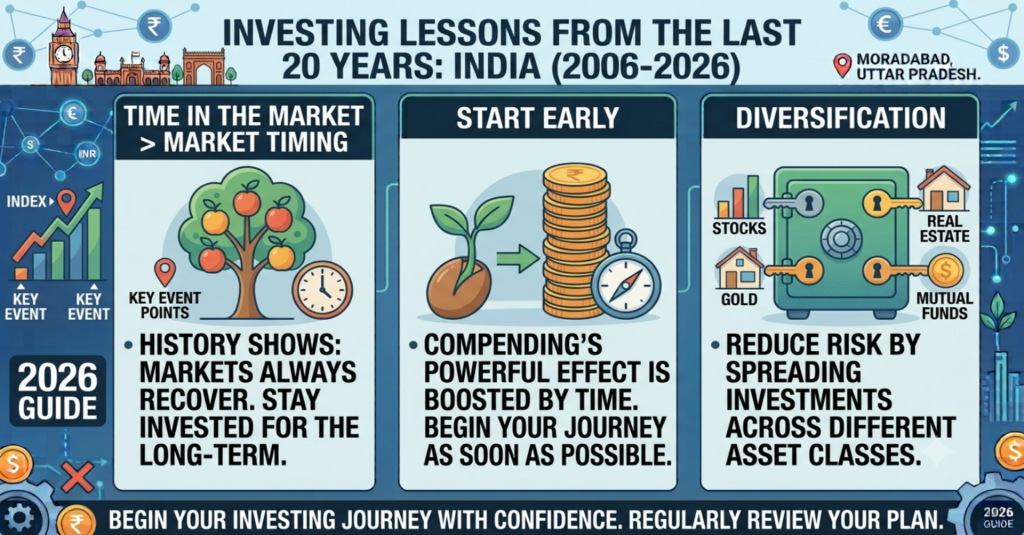
1. Markets Recover Over Time
History shows that markets have experienced many temporary declines.
However, long-term investors have often benefited from staying invested through periods of uncertainty.
Short-term market movements can feel uncomfortable.
Nevertheless, reacting emotionally to every downturn may hurt long-term investment performance.
Patience remains one of an investor’s greatest strengths.
2. Diversification Reduces Risk
Putting all your money into a single investment increases risk.
Diversification spreads investments across different asset classes, industries, and companies.
A diversified portfolio may help:
- Reduce overall risk.
- Improve long-term stability.
- Limit the impact of one poor-performing investment.
- Create a more balanced investment strategy.
Diversification does not eliminate risk.
However, it helps manage it more effectively.
3. Consistency Often Beats Timing
Many investors try to predict the perfect time to buy or sell.
Unfortunately, consistently timing the market is extremely difficult.
Instead, investing regularly may help smooth the effects of market fluctuations over time.
Steady contributions often build wealth more effectively than waiting for the “perfect” opportunity.
If market swings make you nervous, read our Should You Invest During Market Volatility? guide to learn practical strategies for staying focused when markets become unpredictable.
4. Emotions Can Be Expensive
Fear and excitement influence many investment decisions.
During market declines, some investors sell out of panic.
During strong rallies, others invest aggressively without a clear plan.
Successful investing usually requires discipline rather than emotional reactions.
Having a long-term strategy helps reduce impulsive decisions.
5. Time Is One of Your Greatest Advantages
The earlier you begin investing, the more time your investments have to grow.
Long investment periods allow returns to build over many years.
Even modest investments made consistently may grow significantly through long-term compounding.
Starting early often matters more than investing large amounts later.
6. Economic Conditions Always Change
During the past 20 years, investors have experienced:
- Market corrections.
- High inflation.
- Low interest rates.
- Rising interest rates.
- Economic expansions.
- Economic slowdowns.
Markets continually adapt to changing conditions.
Investors who maintain long-term perspectives are often better prepared for uncertainty.
Focus on the Long Term
Short-term headlines change every day.
Long-term investing principles remain surprisingly consistent.
Building wealth usually depends more on patience, discipline, and consistency than on predicting tomorrow’s market movements.
7. Regular Portfolio Reviews Matter
Investing is not something you set up once and forget forever.
Your financial goals, risk tolerance, and life circumstances change over time.
Reviewing your portfolio periodically helps you:
- Keep your investments aligned with your goals.
- Rebalance your asset allocation.
- Reduce unnecessary risk.
- Identify underperforming investments.
A regular review—such as once or twice a year—is often enough for many long-term investors.
8. Avoid Following Every Market Headline
Financial news is available 24 hours a day.
While staying informed is helpful, reacting to every headline can lead to poor investment decisions.
Instead of making changes based on daily news:
- Focus on your long-term plan.
- Review trusted financial information.
- Ignore short-term market noise.
- Make decisions based on your goals, not emotions.
Successful investors often avoid making frequent changes based on temporary events.
9. Keep Investment Costs Under Control
Investment fees may seem small, but they can reduce long-term returns over many years.
Pay attention to:
- Fund expense ratios.
- Trading commissions.
- Advisory fees.
- Account maintenance fees.
Lower investment costs may allow more of your money to remain invested and continue growing over time.
10. Investing Is a Long-Term Journey
The biggest lesson from the last 20 years is that investing rewards patience.
Markets will experience:
- Bull markets.
- Bear markets.
- Economic uncertainty.
- Periods of strong growth.
- Unexpected global events.
Despite these changes, disciplined investors who stay focused on long-term goals are often better positioned to build wealth over time.
Common Investing Mistakes to Avoid
Many investors repeat the same mistakes during every market cycle.
Avoid these common errors:
- Trying to time the market.
- Investing without diversification.
- Making emotional decisions.
- Ignoring investment fees.
- Chasing recent winners.
- Failing to review your portfolio.
- Investing without clear financial goals.
Learning from these mistakes can help you become a more confident investor.
Investor.gov, the U.S. Securities and Exchange Commission’s investor education website, provides reliable information about diversification, long-term investing, investment risk, and avoiding common investing mistakes. Reviewing these resources can help you make informed financial decisions.
Frequently Asked Questions
What is the biggest investing lesson from the past 20 years?
One of the most important lessons is that markets experience temporary ups and downs, but long-term investing and consistent contributions have historically rewarded patient investors.
Should I change my investments every time the market changes?
Not necessarily.
Frequent changes based on short-term market movements may increase risk and reduce long-term performance.
Review your investments based on your financial goals rather than daily market news.
How often should I review my investment portfolio?
Many financial professionals suggest reviewing your portfolio at least once or twice a year or after major life changes.
Regular reviews help keep your investments aligned with your objectives.
Is diversification still important today?
Yes.
Diversification remains one of the most effective ways to manage investment risk because it reduces dependence on a single company, industry, or asset class.
Final Thoughts
The last 20 years have shown that markets will always change.
Economic conditions, interest rates, inflation, and investor sentiment will continue to evolve.
What has remained consistent is the value of patience, diversification, disciplined investing, and long-term thinking.
Rather than trying to predict every market move, focus on building a plan you can follow through different market cycles.
That approach gives you a stronger foundation for achieving your long-term financial goals.