 MOHAMMAD ABUBAKR
When you deposit money into a bank, you expect it to be safe. However, many people wonder what would happen if their bank suddenly closed. Could they lose their savings? Fortunately, most Americans don’t have to worry because of FDIC insurance.
The Federal Deposit Insurance Corporation (FDIC) protects eligible deposits at insured banks. This protection gives millions of Americans confidence that their money is secure, even if a bank fails.
Still, many savers do not fully understand how FDIC insurance works. They may not know what accounts are covered, what the coverage limits are, or how to maximize their protection.
In this guide, you’ll learn everything you need to know about FDIC insurance, including who qualifies, what is covered, and how to make sure your savings remain protected.
What Is FDIC Insurance?
FDIC insurance is a federal program that protects depositors if an FDIC-insured bank fails.
The Federal Deposit Insurance Corporation was created in 1933 after thousands of banks failed during the Great Depression. Its purpose is simple: to protect customers and maintain confidence in the U.S. banking system.
Today, thousands of banks across the United States are FDIC-insured. If one of these banks fails, the FDIC steps in to protect eligible deposits up to the legal coverage limits.
As a result, depositors generally do not lose their insured money.
Is Your Money Safe If Your Bank Fails?
How Does FDIC Insurance Work?
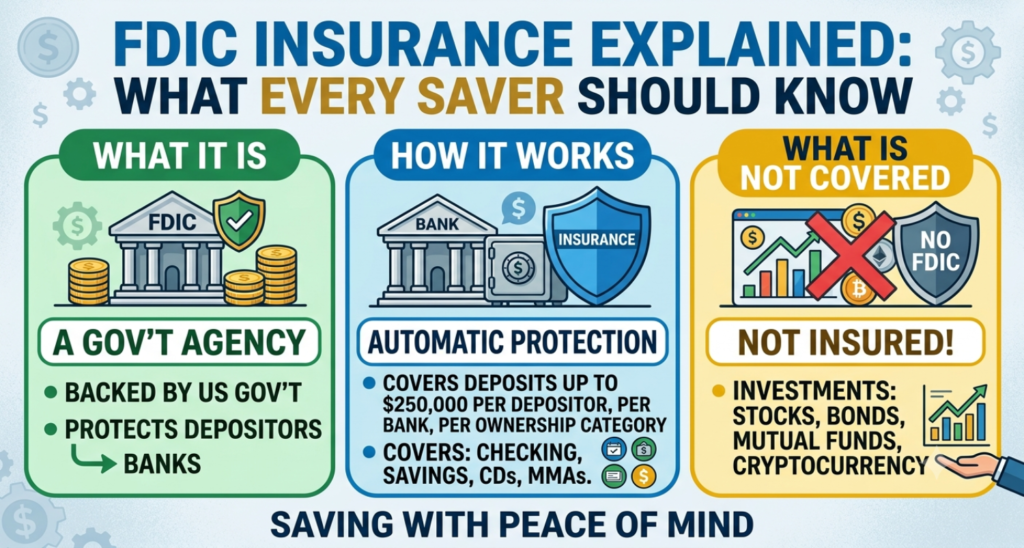
FDIC insurance automatically protects eligible deposits at participating banks. You do not need to apply or pay for this coverage.
If an insured bank closes, the FDIC usually transfers deposits to another insured bank or sends customers their insured funds within a short period.
In many cases, customers regain access to their insured deposits by the next business day.
How Much Does FDIC Insurance Cover?
The standard FDIC insurance limit is:
$250,000 per depositor, per insured bank, per ownership category.
This means your coverage depends on three factors:
- The amount of money you have.
- The ownership type of your account.
- Whether your money is spread across different insured banks.
Because coverage applies by ownership category, many households can qualify for more than $250,000 in total protection.
What Accounts Are Covered?
FDIC insurance protects many common deposit accounts, including:
- Checking accounts
- Savings accounts
- Money market deposit accounts
- Certificates of Deposit (CDs)
- Cashier’s checks
- Official bank checks
These are considered deposit products and are generally covered up to the applicable insurance limits.
What Is Not Covered?
Not every financial product offered through a bank qualifies for FDIC protection.
FDIC insurance does not cover:
- Stocks
- Bonds
- Mutual funds
- Exchange-Traded Funds (ETFs)
- Cryptocurrency
- Annuities
- Life insurance products
- U.S. Treasury securities held as investments
Although you may purchase some of these products through a bank, they are investment products rather than insured deposits.
Understanding Ownership Categories
Many people mistakenly believe the $250,000 limit applies to everything they own at one bank.
In reality, FDIC insurance is based on ownership categories.
Common ownership categories include:
Individual Accounts
Coverage is generally up to $250,000 for each owner.
Joint Accounts
Joint accounts may qualify for up to $250,000 in coverage per co-owner, provided FDIC requirements are met.
Certain Retirement Accounts
Eligible retirement deposit accounts can receive separate insurance coverage.
Understanding these categories can help you maximize your protection without changing banks.
What Happens If Your Bank Fails?
Although bank failures are uncommon, they do happen.
When an insured bank fails:
- Federal regulators close the bank.
- The FDIC becomes the receiver.
- Another bank often acquires the deposits.
- Customers usually continue accessing their money with minimal interruption.
Most direct deposits, debit cards, and automatic payments continue working after the transition.
How to Check Whether Your Bank Is FDIC-Insured
Checking your bank’s status is easy.
Look for the official “Member FDIC” logo at:
- Bank branches
- Mobile banking apps
- Bank websites
You can also use the FDIC’s online BankFind Suite to verify whether a financial institution is insured.
Never assume a financial company offers FDIC insurance unless you confirm it.
How to Maximize Your FDIC Coverage
If you have substantial savings, consider these strategies.
Stay Within Coverage Limits
Keep deposits below the applicable insurance limit whenever possible.
Use Multiple Banks
Deposits at separate FDIC-insured banks receive separate coverage.
Use Different Ownership Categories
Individual, joint, and eligible retirement accounts may each qualify for separate insurance.
Review Your Accounts Regularly
Large balances can grow over time. Reviewing your accounts helps ensure you remain fully protected.
Common FDIC Insurance Myths
Myth 1: Every Bank Is FDIC-Insured
Not all financial institutions participate in the FDIC program.
Always verify before opening an account.
Myth 2: Investments Are Covered
Only eligible deposit accounts receive FDIC insurance.
Investments remain subject to market risk.
Myth 3: You Must Purchase FDIC Insurance
Coverage is automatic for eligible deposits held at insured banks.
There is no separate application or fee.
Myth 4: You Will Wait Months for Your Money
In many cases, customers regain access to insured deposits within one business day after a bank failure.
Why FDIC Insurance Matters
FDIC insurance helps protect families, retirees, students, and businesses from losing insured deposits if a bank fails.
Without this protection, people could lose savings needed for:
- Mortgage payments
- Rent
- Medical bills
- Retirement
- College expenses
- Emergency funds
The system helps maintain confidence in the banking industry and reduces the risk of widespread financial panic.
Frequently Asked Questions
Is every bank account insured?
Eligible deposit accounts at FDIC-insured banks are generally covered.
Does FDIC insurance cover online banks?
Many online banks are FDIC-insured. Always verify before opening an account.
Can I have more than $250,000 insured?
Yes. Using different ownership categories or multiple FDIC-insured banks may increase your total insured coverage.
Is my checking account protected?
Yes. Checking accounts are eligible for FDIC insurance when held at insured banks.
What if my bank merges with another bank?
The FDIC provides rules that help maintain deposit insurance during bank mergers. Your coverage may continue for a transition period.
FDIC (Federal Deposit Insurance Corporation)
Final Thoughts
FDIC insurance is one of the strongest consumer protections available to U.S. bank customers. It safeguards eligible deposits if an insured bank fails, helping millions of Americans keep their savings secure.
Understanding what is covered, knowing the insurance limits, and organizing your accounts wisely can provide peace of mind and protect your financial future. Whether you are opening your first savings account or managing significant deposits, taking a few minutes to understand FDIC insurance is well worth the effort.
By banking with FDIC-insured institutions and staying within coverage limits, you can confidently save for your goals while knowing your eligible deposits are protected.