 MOHAMMAD ABUBAKR
Many Americans trust banks with their savings. However, news about bank failures often creates fear. People start asking the same question: Is your money safe if your bank fails?
The good news is that, in most cases, yes, your money is safe. The United States has strong banking protections. Most deposits are covered by federal insurance. Therefore, even if a bank closes, customers usually get their insured money back.
Still, it is important to understand how the system works. Once you know the rules, you can protect every dollar you earn.
This guide explains what happens when a bank fails, how FDIC insurance works, and what smart steps you should take to keep your money secure.
What Does It Mean When a Bank Fails?
A bank fails when it no longer has enough money to meet its financial obligations. This usually happens because of poor investments, heavy losses, or a sudden wave of customer withdrawals.
When regulators determine that a bank cannot continue operating safely, they close it. Then, the Federal Deposit Insurance Corporation (FDIC) steps in.
Instead of allowing customers to lose their savings, the FDIC manages the process. In many cases, another bank takes over the failed bank’s accounts. As a result, customers can continue using their money with little interruption.
The Biggest Banking Mistakes That Cost Americans Money
What Is FDIC Insurance?
FDIC insurance protects money deposited in insured banks.
It covers common deposit accounts, including:
- Checking accounts
- Savings accounts
- Money market deposit accounts
- Certificates of Deposit (CDs)
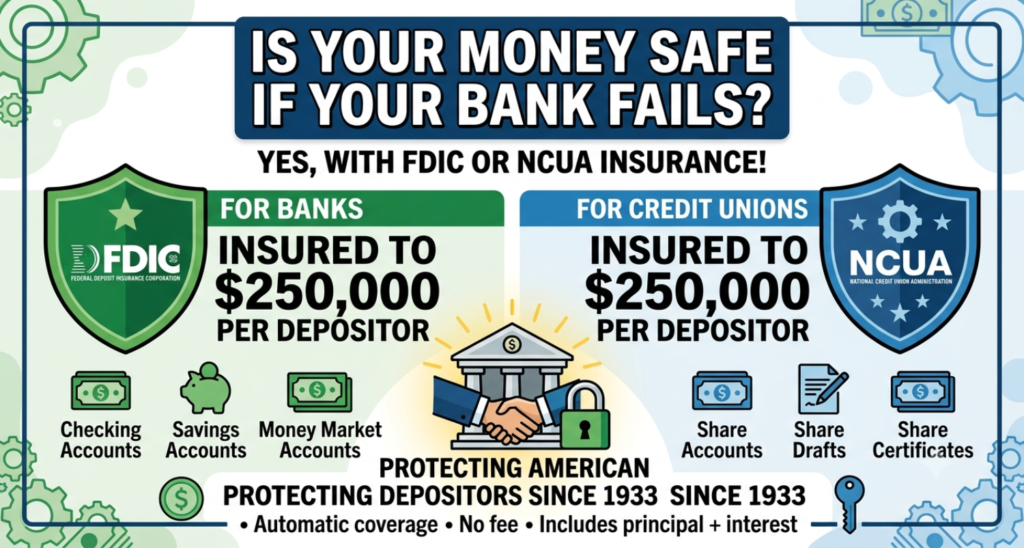
Currently, the FDIC insures up to $250,000 per depositor, per insured bank, per ownership category.
That means if your balance falls within the insurance limit, you will not lose your insured deposits because your bank fails.
For most Americans, this coverage is more than enough.
What Is Not Covered by FDIC Insurance?
Many people believe every financial product at a bank is insured. That is not true.
FDIC insurance does not cover:
- Stocks
- Bonds
- Mutual funds
- Exchange-Traded Funds (ETFs)
- Cryptocurrency
- Life insurance products
- Annuities
Even if you buy these investments through your bank, they remain investment products. Therefore, their value can rise or fall with the market.
How Much Money Is Protected?
Many people misunderstand the $250,000 insurance limit.
The limit applies per ownership category, not simply per person.
For example:
- One individual account = up to $250,000 insured.
- Joint account with your spouse = up to $500,000 insured.
- Retirement accounts may qualify for separate coverage.
Because of these ownership categories, many families can protect much more than $250,000 legally.
What Happens Immediately After a Bank Fails?
A bank failure may sound dramatic. However, customers usually experience very little disruption.
In most situations:
- Regulators close the bank.
- The FDIC becomes the receiver.
- Another bank purchases the failed bank.
- Customers automatically become customers of the new bank.
Most debit cards, checks, direct deposits, and automatic bill payments continue working.
Sometimes, customers may briefly lose online banking access during the transition. However, service usually returns quickly.
How Long Does It Take to Get Your Money?
Many people worry they will wait months for their savings.
Fortunately, that rarely happens.
The FDIC usually provides access to insured deposits within one business day after the bank closes.
As a result, customers can continue paying bills and managing daily expenses with minimal delays.
What If You Have More Than $250,000?
Having more than the insurance limit does not automatically mean you will lose money.
Instead, you should spread your deposits strategically.
Many wealthy Americans use several insured banks.
For example:
- Bank A: $250,000
- Bank B: $250,000
- Bank C: $250,000
Each account receives separate FDIC protection because each bank is independently insured.
Likewise, different ownership categories may increase your insured coverage even further.
Should You Withdraw Cash During Banking Panic?
When people hear rumors about bank problems, many rush to withdraw cash.
However, this is usually unnecessary.
If your deposits are fully insured, your money remains protected.
Keeping large amounts of cash at home creates new risks, including:
- Theft
- Fire
- Natural disasters
- Loss
Instead of panicking, verify whether your bank is FDIC-insured and confirm your balances remain within insurance limits.
How Can You Check If Your Bank Is FDIC Insured?
Checking is simple.
Most insured banks display the official FDIC logo:
“Member FDIC.”
You can also search the FDIC’s online database to confirm coverage before opening an account.
Never assume every financial institution offers FDIC insurance.
Some online financial companies partner with insured banks, while others do not.
Always verify first.
Are Credit Unions Protected?
Yes.
Although credit unions are not covered by the FDIC, they have similar federal protection.
Most federally chartered credit unions receive insurance through the National Credit Union Administration (NCUA).
The coverage amount is generally the same:
Up to $250,000 per depositor, per ownership category.
Therefore, members receive similar protection.
Warning Signs of a Troubled Bank
Most customers never notice problems before regulators step in.
Still, you should pay attention to major warning signs.
These include:
- Negative financial headlines
- Rapid executive resignations
- Large investment losses
- Falling stock prices
- Heavy customer withdrawals
- Government investigations
One warning sign alone does not guarantee failure.
However, staying informed helps you make better financial decisions.
Smart Ways to Protect Your Money
Protecting your savings does not require complicated strategies.
Instead, follow these practical tips.
1. Stay Within Insurance Limits
Keep balances below FDIC coverage whenever possible.
2. Use Multiple Banks
Large savings can be divided among different insured banks.
3. Review Account Ownership
Joint accounts and retirement accounts may increase insurance protection.
4. Monitor Your Accounts
Review balances regularly to avoid exceeding insurance limits.
5. Keep Emergency Savings
Maintain enough cash for several months of expenses in insured accounts.
6. Avoid Panic Decisions
Reacting emotionally often creates unnecessary financial stress.
Instead, rely on verified information.
Lessons From Recent Bank Failures
Recent U.S. bank failures reminded Americans that even established financial institutions can face challenges.
However, they also demonstrated how effective deposit insurance can be.
Millions of customers regained access to insured deposits quickly.
This shows why federal insurance remains one of the strongest consumer protections in the American banking system.
Frequently Asked Questions
Can I lose money if my bank fails?
If your deposits stay within FDIC insurance limits, you generally will not lose your insured money.
Does FDIC cover checking accounts?
Yes. Checking accounts are fully covered up to the insurance limit.
Is cash at home safer?
Usually not. Cash at home can be stolen, destroyed, or lost.
What if my bank merges with another bank?
Your accounts usually transfer automatically. Deposit insurance rules continue to apply.
Are online banks insured?
Many online banks are FDIC-insured. However, you should always verify before opening an account.
Final Thoughts
So, is your money safe if your bank fails?
For most Americans, the answer is yes.
Federal deposit insurance protects eligible deposits up to legal limits. Therefore, bank failures rarely mean customers lose their insured savings.
Nevertheless, smart financial planning remains important. Keep your money within FDIC insurance limits. Spread large balances across multiple insured banks when necessary. Review your accounts regularly. Above all, avoid making decisions based on fear.
o understand your coverage in detail, visit the FDIC Deposit Insurance Coverage page provided by the Federal Deposit Insurance Corporation.
Bank failures can make headlines. Yet, understanding how deposit insurance works gives you confidence and peace of mind. With the right strategy, your savings can stay protected no matter what happens in the banking industry.
FAQ Schema Keywords (SEO Bonus)
- Is your money safe if your bank fails?
- FDIC insurance explained
- What happens when a bank fails
- How much does FDIC insure?
- Are checking accounts FDIC insured?
- Can you lose money in a bank failure?
- Bank failure protection USA
- FDIC deposit insurance limits
- Safe banking tips
- Protect your savings account
Primary Keyword Used Throughout: Is Your Money Safe If Your Bank Fails in the USA and FDIC Insurance