 MOHAMMAD ABUBAKR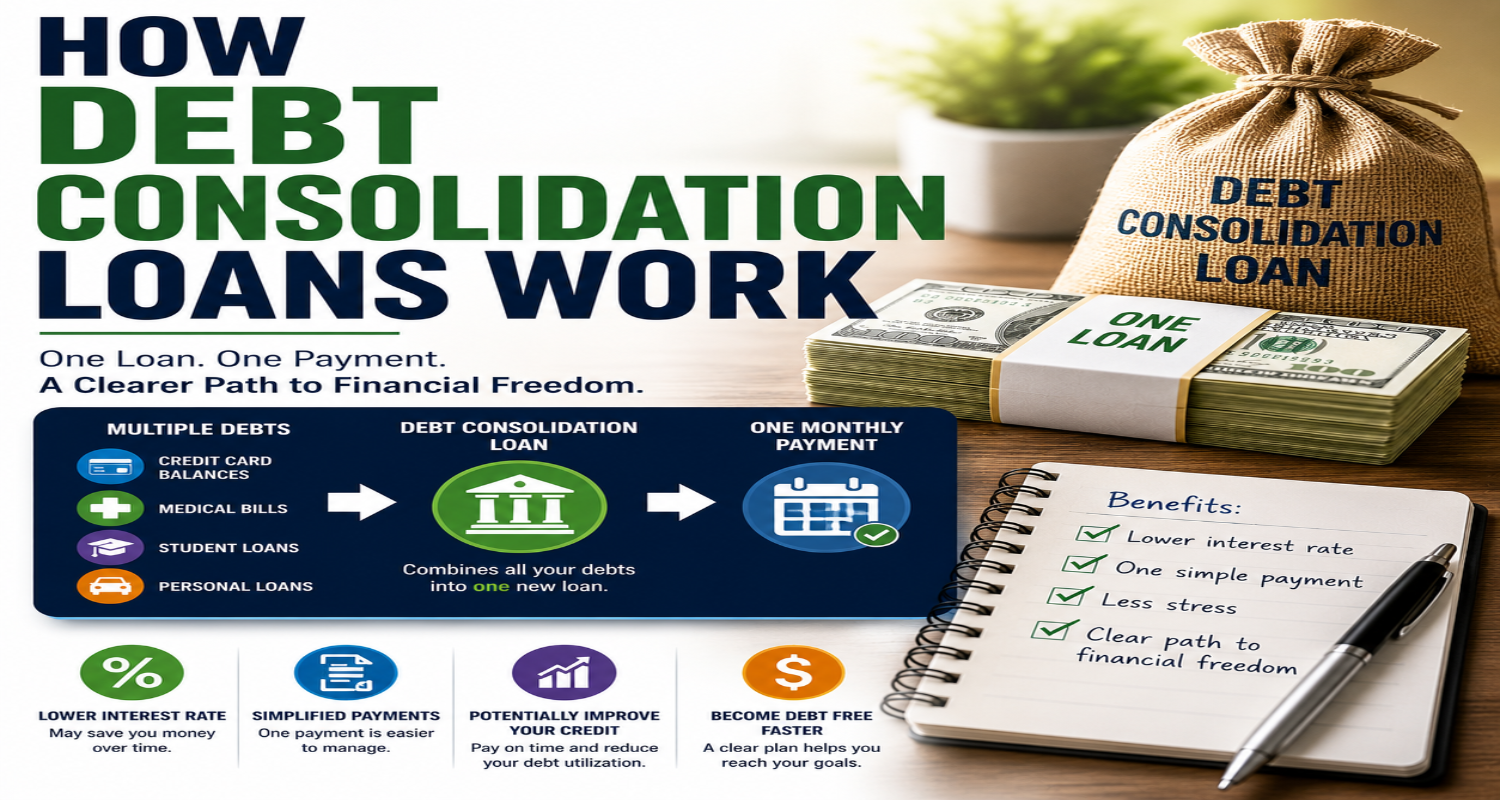
Managing several debts at once can quickly become overwhelming. Credit cards, personal loans, medical bills, and other balances often come with different due dates and interest rates. As a result, staying organized becomes more difficult. Missing even one payment may hurt your credit score and increase your debt.
A debt consolidation loan can help simplify your finances by combining multiple debts into one new loan. Instead of paying several creditors each month, you make one monthly payment to a single lender.
In this guide, you’ll learn how debt consolidation loans work, their advantages and disadvantages, qualification requirements, and whether this financial strategy is right for you.
What Is a Debt Consolidation Loan?
A debt consolidation loan is a personal loan used to pay off multiple existing debts.
After the new loan pays your balances, you only repay the new lender. This means you have one payment, one due date, and one interest rate.
Debt consolidation does not erase debt. Instead, it reorganizes your existing debt into a single loan that may be easier to manage.
How Personal Loan Interest Rates Are Calculated.
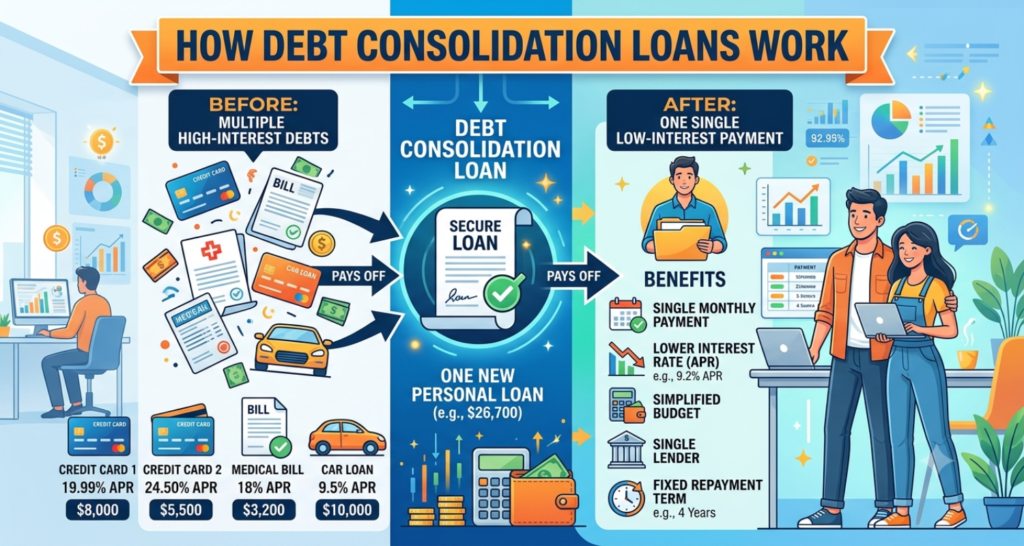
How Debt Consolidation Loans Work
The process is usually simple.
Step 1: Apply for a Loan
You apply with a bank, credit union, or online lender.
The lender reviews your:
- Credit score
- Income
- Employment history
- Debt-to-income ratio
- Existing debts
Step 2: Receive Loan Approval
If approved, you’ll receive a loan amount large enough to cover your qualifying debts.
Some lenders send funds directly to your creditors.
Others deposit the money into your bank account so you can pay the balances yourself.
Step 3: Pay Off Existing Debts
Use the loan proceeds to eliminate debts such as:
- Credit cards
- Medical bills
- Personal loans
- Store financing
- Payday loan alternatives (when eligible)
Afterward, those accounts should show zero balances once payments are processed.
Step 4: Repay One Loan
Instead of several monthly payments, you’ll repay only the new consolidation loan.
This often makes budgeting much easier.
Example of Debt Consolidation
Suppose you currently owe:
| Debt | Balance | Interest Rate |
|---|---|---|
| Credit Card A | $5,000 | 25% |
| Credit Card B | $3,000 | 22% |
| Personal Loan | $7,000 | 15% |
Total Debt: $15,000
Instead of managing three payments, you receive a debt consolidation loan for $15,000 at a 10% interest rate.
Now you have:
- One lender
- One monthly payment
- Lower interest costs (if you qualify)
- Easier repayment tracking
Benefits of Debt Consolidation Loans
1. One Monthly Payment
Managing one payment is much simpler than tracking multiple due dates.
This also reduces the risk of late payments.
2. Lower Interest Rate
Many borrowers qualify for interest rates lower than credit cards.
Lower rates may reduce the total interest paid over time.
3. Fixed Monthly Payments
Most debt consolidation loans have fixed interest rates.
That means your payment usually stays the same throughout the loan term.
Predictable payments make budgeting easier.
4. Faster Debt Payoff
Many borrowers become debt-free sooner because they follow one structured repayment schedule.
5. Improved Credit Score Over Time
If you continue making payments on time and avoid adding new debt, your credit score may improve.
Lower credit utilization can also have a positive impact.
Potential Drawbacks
Debt consolidation isn’t perfect for everyone.
Consider these disadvantages.
Origination Fees
Some lenders charge upfront loan fees.
These may range from 1% to 8% of the loan amount.
Longer Repayment Period
A lower monthly payment sometimes means extending your repayment timeline.
As a result, you could pay more interest overall.
Doesn’t Solve Spending Habits
Consolidation addresses existing debt.
However, it won’t prevent future debt if spending habits don’t change.
Qualification Requirements
Borrowers with poor credit may receive higher interest rates or may not qualify.
Who Should Consider Debt Consolidation?
Debt consolidation may work well if you:
- Have multiple high-interest debts
- Want one monthly payment
- Qualify for a lower interest rate
- Have reliable income
- Want a structured repayment plan
Who May Want to Wait?
Debt consolidation may not be the best option if you:
- Already have very low interest rates
- Cannot qualify for better loan terms
- Continue increasing credit card balances
- Have very little income
What Lenders Look For
Before approving a debt consolidation loan, lenders usually review:
Credit Score
Higher scores often qualify for better rates.
Income
Steady income shows repayment ability.
Debt-to-Income Ratio
Lower DTI ratios improve approval chances.
Employment Stability
Long-term employment demonstrates financial reliability.
Payment History
On-time payments increase lender confidence.
Secured vs. Unsecured Debt Consolidation Loans
Secured Loans
These require collateral, such as:
- Home
- Vehicle
- Savings account
Advantages:
- Lower interest rates
- Larger loan amounts
Disadvantages:
- Risk of losing collateral if payments are missed
Unsecured Loans
These require no collateral.
Advantages:
- No asset risk
- Faster approval
Disadvantages:
- Higher interest rates for some borrowers
How to Increase Approval Chances
Improve your application before applying.
Check Your Credit Report
Correct any reporting errors.
Pay Down Credit Cards
Lower balances improve your credit utilization.
Avoid New Debt
Don’t apply for multiple loans before submitting your application.
Improve Your Income
Additional income strengthens your financial profile.
Compare Multiple Lenders
Different lenders offer different rates and requirements.
Shopping around may help you save money.
Common Mistakes to Avoid
Many borrowers make avoidable mistakes.
Avoid these:
- Closing paid-off credit cards immediately
- Continuing to use credit cards after consolidation
- Missing loan payments
- Borrowing more than necessary
- Ignoring loan fees
- Choosing the longest repayment term without comparing total costs
Does Debt Consolidation Hurt Your Credit?
Initially, your credit score may decrease slightly because of the lender’s hard credit inquiry.
However, responsible repayment often improves your credit over time.
Benefits may include:
- Lower credit utilization
- Better payment history
- Simpler debt management
Alternatives to Debt Consolidation Loans
If consolidation isn’t the best fit, consider:
- Balance transfer credit cards
- Debt management plans
- Debt settlement (for severe hardship)
- Snowball repayment method
- Avalanche repayment method
- Budget adjustments and extra monthly payments
Each option has advantages depending on your financial situation.
Final Thoughts
Understanding how debt consolidation loans work to simplify multiple debts can help you take control of your finances. By replacing several debts with one manageable loan, you may lower your interest rate, simplify monthly payments, and create a clear path toward becoming debt-free.
However, consolidation works best when paired with responsible financial habits. Continue making payments on time, avoid accumulating new debt, and stick to a realistic budget. Before choosing a lender, compare interest rates, fees, repayment terms, and eligibility requirements. With careful planning, a debt consolidation loan can become an effective tool for improving your financial health and reducing long-term debt stress.
Consumer Financial Protection Bureau (CFPB):
Frequently Asked Questions (FAQs)
Is a debt consolidation loan the same as debt forgiveness?
No. Debt consolidation combines existing debts into one loan. You still repay the full amount.
Can I consolidate credit card debt?
Yes. Many borrowers use debt consolidation loans to pay off multiple credit card balances.
Does debt consolidation lower monthly payments?
It can, especially if you qualify for a lower interest rate or a longer repayment term.
What credit score is needed?
Many lenders prefer a credit score of 670 or higher, although some accept lower scores depending on your overall financial profile.
Is debt consolidation worth it?
It may be worthwhile if you can reduce your interest rate, simplify repayment, and avoid taking on additional debt.