
 MOHAMMAD ABUBAKR
Buying a home is one of the biggest financial decisions you’ll ever make, but it’s also one of the most misunderstood. Many first-time buyers rely on outdated advice, social media posts, or stories from friends and family when it comes to home financing. Unfortunately, believing these myths can delay your homeownership goals or lead to costly mistakes.
The truth is that today’s mortgage market offers a wide range of loan options, down payment requirements, and financing programs. Understanding how home financing really works can help you make smarter decisions and avoid unnecessary stress during the buying process.
In this guide, we’ll break down the most common home financing misconceptions, explain the facts behind each one, and help you prepare for a successful home purchase.
Why Understanding Home Financing Matters
Your mortgage will likely be your largest financial obligation for many years. Making decisions based on myths instead of facts could result in:
- Paying more than necessary
- Delaying your home purchase
- Choosing the wrong mortgage
- Damaging your financial health
- Missing opportunities to qualify for better loan terms
Learning the facts helps you buy with confidence.
Home Buying Costs Most People Forget
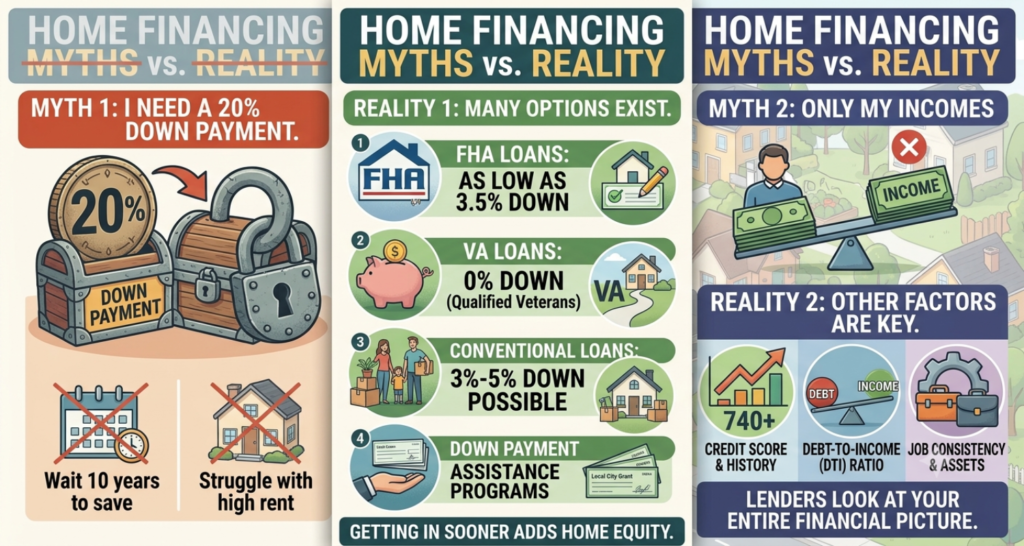
Misconception 1: You Need a 20% Down Payment
This is one of the biggest myths about buying a home.
While putting down 20% has benefits—such as avoiding Private Mortgage Insurance (PMI) on many conventional loans—it is not required for every mortgage.
Many lenders offer loans with much smaller down payments, depending on your financial situation and the loan program.
A smaller down payment may allow you to buy a home sooner while continuing to build savings.
Misconception 2: A Perfect Credit Score Is Required
Many buyers believe they need an excellent credit score before applying for a mortgage.
In reality, lenders consider several factors, including:
- Credit history
- Income
- Employment stability
- Debt-to-income (DTI) ratio
- Savings
A higher credit score may qualify you for better interest rates, but you don’t necessarily need a perfect score to become a homeowner.
Misconception 3: Getting Pre-Approved Guarantees a Loan
A mortgage pre-approval is an important step, but it is not a final loan approval.
Before closing, lenders typically verify:
- Employment
- Income
- Credit
- Assets
- Property appraisal
Major financial changes after pre-approval—such as taking on new debt or changing jobs—can affect your final approval.
Misconception 4: Your Mortgage Payment Is Your Only Housing Expense
Many first-time buyers focus only on the monthly mortgage payment.
However, homeownership also includes:
- Property taxes
- Homeowners insurance
- Utilities
- Home maintenance
- Repairs
- HOA fees (if applicable)
Budgeting for these additional costs is essential.
Misconception 5: You Should Borrow the Maximum Amount You’re Approved For
Just because a lender approves a larger loan doesn’t mean you should borrow the full amount.
Instead, choose a home that fits comfortably within your budget while allowing you to:
- Save for retirement
- Build an emergency fund
- Pay other bills
- Enjoy your lifestyle
Buying below your maximum borrowing limit provides greater financial flexibility.
Misconception 6: The Lowest Interest Rate Is Always the Best Deal
A low interest rate is important, but it isn’t the only factor.
Compare:
- Closing costs
- Loan fees
- Loan term
- Discount points
- Annual Percentage Rate (APR)
Sometimes a slightly higher interest rate with lower fees can save you money over time.
Misconception 7: Renting Is Always Wasting Money
Many people believe renting offers no financial value.
In reality, renting may make sense if you:
- Expect to move soon
- Need flexibility
- Are still building savings
- Aren’t ready for maintenance responsibilities
Buying isn’t automatically the better choice for every situation.
Misconception 8: You Should Always Choose the Longest Loan Term
Longer mortgage terms often reduce monthly payments, but they usually increase the total interest paid over the life of the loan.
Shorter loan terms typically:
- Build equity faster
- Reduce total interest costs
- Lead to earlier mortgage payoff
Choose a loan term that aligns with your financial goals.
Misconception 9: You Can’t Pay Off Your Mortgage Early
Many homeowners believe they must keep their mortgage for the full loan term.
In fact, many loans allow you to make extra principal payments without penalties.
Paying extra can:
- Reduce interest costs
- Build equity faster
- Shorten the loan term
Always review your mortgage agreement for any prepayment conditions.
Misconception 10: Mortgage Rates Are the Same Everywhere
Mortgage rates vary between lenders.
Rates are influenced by:
- Credit score
- Down payment
- Loan type
- Market conditions
- Lender pricing
Comparing multiple lenders may help you secure better financing.
Misconception 11: Closing Costs Are Included in the Mortgage
Closing costs are often paid separately at closing unless they’re rolled into the loan under certain programs.
These costs may include:
- Loan origination fees
- Appraisal fees
- Title insurance
- Recording fees
- Legal fees (where applicable)
Many buyers overlook these upfront expenses.
Misconception 12: You Should Make a Large Down Payment Even If It Drains Your Savings
While a larger down payment can reduce your loan balance, using all your savings isn’t always wise.
It’s important to keep enough money for:
- Emergency expenses
- Home repairs
- Moving costs
- Furniture
- Closing costs
Maintaining financial flexibility is just as important as reducing your mortgage.
How to Make Smarter Home Financing Decisions
Follow these best practices before applying for a mortgage:
- Review your credit report.
- Compare multiple mortgage lenders.
- Understand your total monthly housing costs.
- Save for both your down payment and closing costs.
- Keep an emergency fund after buying.
- Avoid taking on new debt before closing.
- Read all loan documents carefully.
These steps can improve your financial confidence and reduce surprises.
Common Financing Mistakes to Avoid
Many buyers make avoidable mistakes, including:
- Shopping based only on monthly payments
- Ignoring loan fees
- Failing to compare lenders
- Draining savings for a down payment
- Skipping mortgage pre-approval
- Underestimating homeownership costs
Avoiding these mistakes can help you make a stronger financial decision.
Final Thoughts
Home financing can seem complicated, especially for first-time buyers. However, many of the most common misconceptions are based on outdated information or misunderstandings. By learning how mortgages, down payments, credit scores, and loan approvals actually work, you can make informed decisions and avoid costly mistakes.
The best home financing strategy is one that fits your financial situation, long-term goals, and monthly budget. Taking the time to research your options today can lead to a smoother home-buying experience and greater financial security for years to come.
Consumer Financial Protection Bureau (CFPB):
Frequently Asked Questions (FAQs)
Do I really need a 20% down payment?
No. Many mortgage programs allow qualified buyers to purchase a home with a lower down payment, although putting down 20% may help you avoid PMI on many conventional loans.
Can I get a mortgage with average credit?
Yes. While a higher credit score often leads to better loan terms, many lenders offer mortgages to buyers with good or fair credit, depending on their overall financial profile.
Should I compare mortgage lenders?
Absolutely. Comparing lenders can help you find better interest rates, lower fees, and loan terms that fit your financial needs.
Is mortgage pre-approval the same as final approval?
No. Pre-approval is an initial review of your finances. Final approval typically happens after the lender verifies your information and the property meets lending requirements.